
Hurricane Power Outage Prep: Keep the Lights On When the Storm Hits
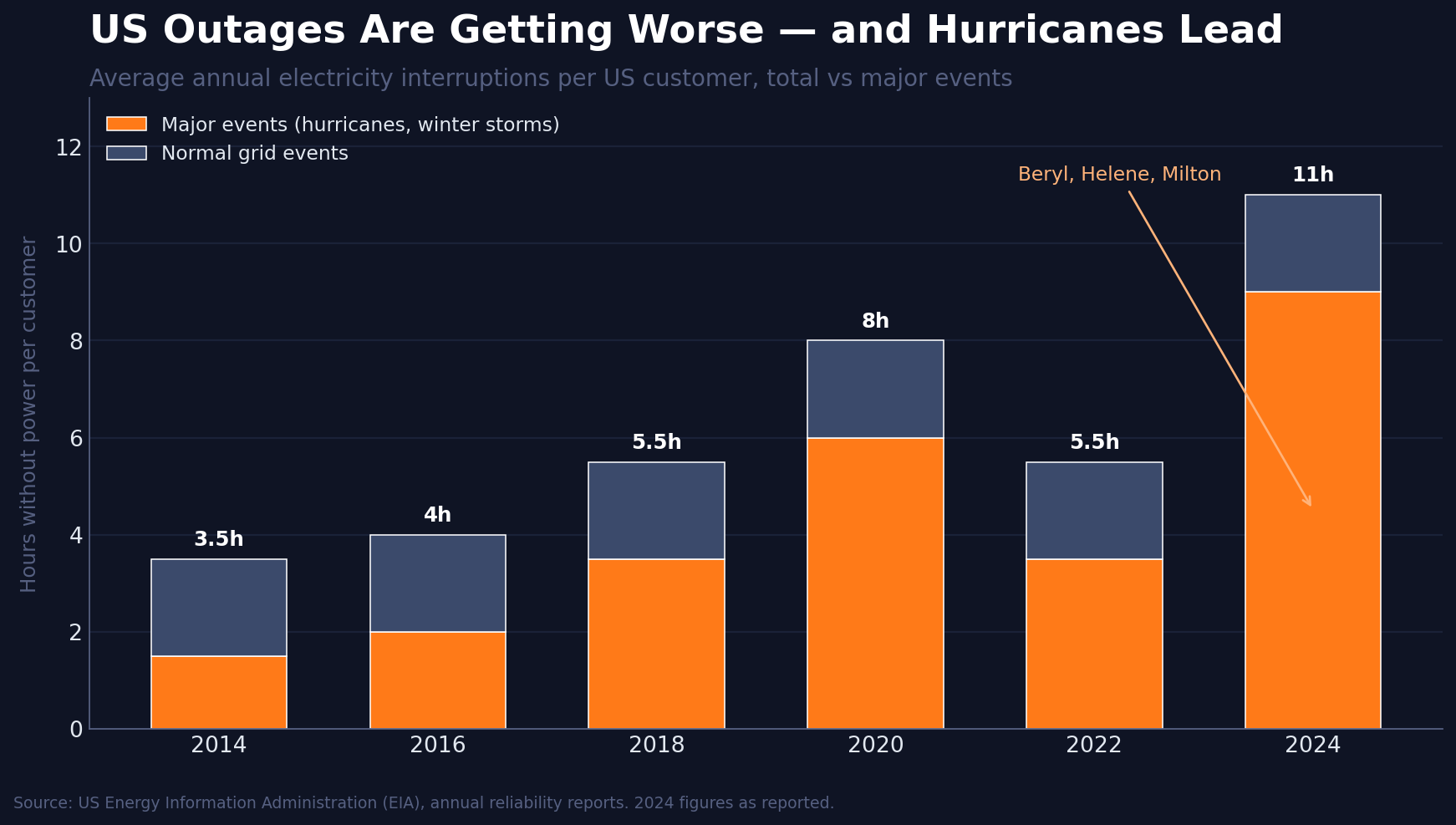
When a hurricane makes landfall, the power usually goes before the rain does. Downed lines, flooded substations, and snapped poles can leave entire regions dark—and in recent years, the outages have been getting dramatically worse. In 2024, U.S. electricity customers lost an average of 11 hours of power, nearly double the typical year, and hurricanes Beryl, Helene, and Milton alone accounted for the vast majority of those lost hours, according to the U.S. Energy Information Administration.
The good news: a hurricane power outage is the most predictable blackout you’ll ever face. You know it’s coming days in advance. That means preparation—done right—turns days of misery into a manageable inconvenience. This guide walks you through exactly what to do, from 72 hours before landfall to after the crews restore power.
Why Hurricanes Knock Out Power So Effectively
Hurricanes attack the grid from every direction at once:
- Wind. Sustained hurricane-force winds and tornado-spinoff bands snap wooden poles, topple transmission towers, and throw debris onto lines.
- Flooding. Storm surge and heavy rain flood substations and underground equipment—often the slowest damage to repair.
- Trees. In the eastern U.S., most outage events start with a tree limb and a power line meeting.
- Preventive shutoffs. Some utilities deliberately cut power to areas at risk of fire or catastrophic equipment damage before the worst arrives.
Restoration is a marathon, not a sprint. Crews must wait for winds to drop below safe working levels before they can even climb—and after a major hurricane, average outage durations run from a couple of days to over a week in the hardest-hit areas. Plan for at least 72 hours without power, and you’ll never be caught short.
72 Hours Before: The Master Checklist
Three days out, your job is supplies and information:
Stock up:
- Water: one gallon per person per day, minimum 3 days (7 if you can)
- Non-perishable food that needs no cooking
- Batteries, flashlights (headlamps beat handheld), and a battery or hand-crank radio
- Any prescription medications, plus baby or pet supplies
- Cash—ATMs and card readers die with the grid
- Fuel for your car and, if you have one, generator (but never store gasoline indoors)
Get informed:
- Sign up for your county’s emergency alerts and know your evacuation zone before the season starts
- Bookmark your utility’s outage map and save its outage-reporting number
- Download the FEMA app for real-time alerts
Prep the house:
- Charge everything: phones, power banks, laptops, and your portable power station to 100%
- Freeze water bottles now—they’ll keep the freezer cold longer and give you drinking water as they melt
- Set fridge and freezer to their coldest settings
- Photograph the inside of your refrigerator for insurance purposes if flooding is expected
24 Hours Before: Last-Minute Moves
- Move your car away from trees, ideally under cover
- Fill the bathtub with water for flushing toilets (not drinking)
- Set phones to low-power mode and dim screens
- Do one final laundry and dish load—clean clothes and dishes matter more than you’d think during a week-long outage
- Unplug sensitive electronics; when power surges back on, it can fry them
- If you own a generator, test-run it now—not at 2 a.m. in the rain
When the Power Goes Out: What to Do First
- Confirm it’s the storm, not you. Check your breaker box, then your utility’s outage map.
- Report it. Even if the map already shows it, reporting helps crews prioritize.
- Keep the fridge and freezer shut. An unopened fridge holds a safe temperature for about 4 hours; a full freezer, about 48 (half-full: 24). Every peek costs you cold air.
- Switch to backup power deliberately. Power the essentials first—phones and medical devices, then the fridge.
- Kill the main breaker if you use a generator or flooding starts. This protects line workers from backfeed and your home from surges.
The food-safety numbers worth memorizing
The full keep-or-toss rules—and how a power station stretches the clock—live in our fridge & freezer safety guide.
- Fridge (unopened): 4 hours
- Freezer, full (unopened): 48 hours
- Freezer, half-full (unopened): 24 hours
- Perishable food above 40°F for more than 2 hours: throw it out. When in doubt, throw it out—food poisoning during a disaster is a hospital trip you can’t afford.
Backup Power: Your Three Realistic Options
This is where most families under-prepare. Here’s the honest breakdown of what makes sense for a hurricane outage:
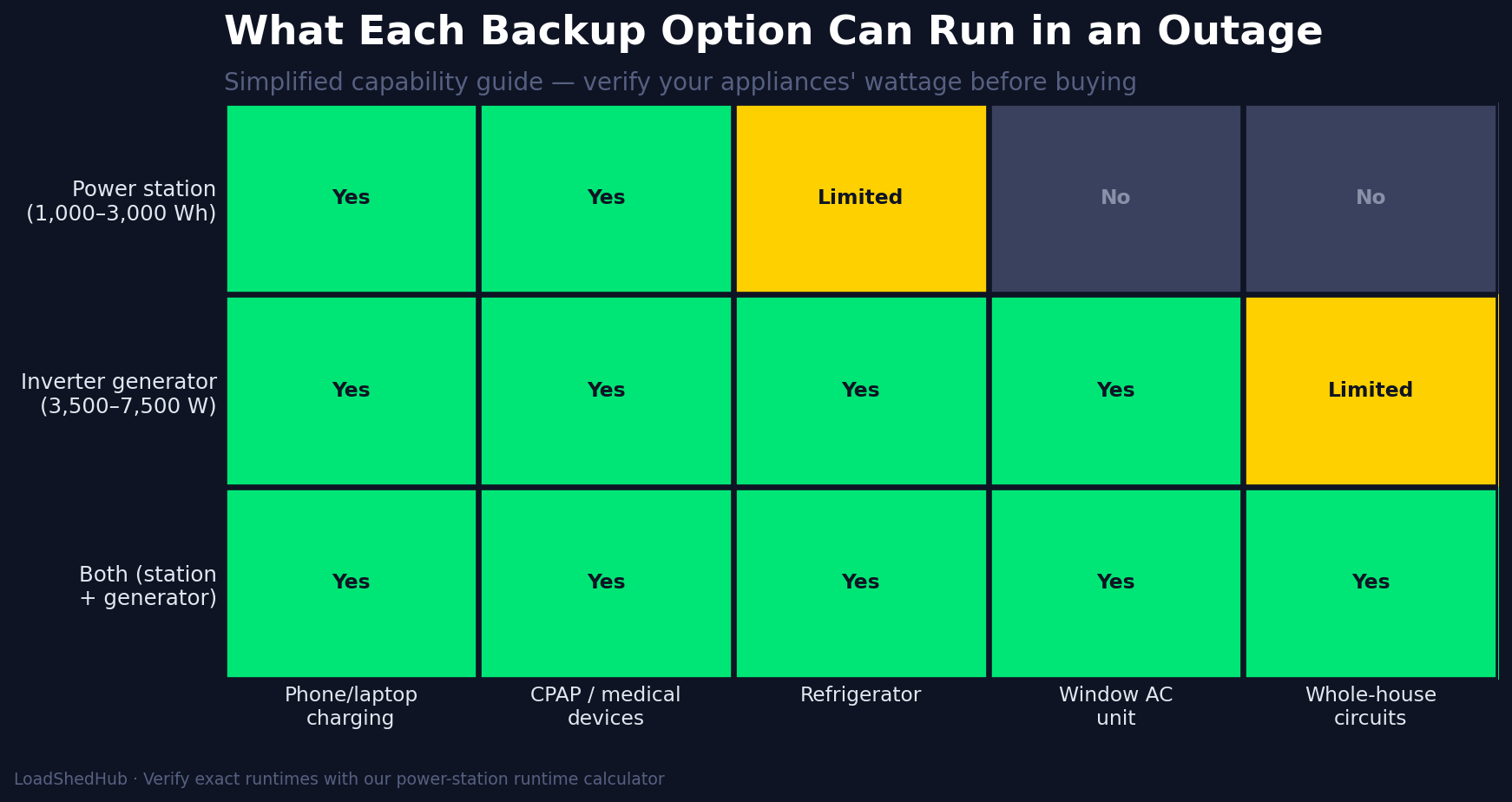
Option 1: Portable power station (most families). A battery unit in the 1,000–3,000 Wh range will run a modern refrigerator 8–24+ hours on a charge, keep phones and laptops alive for days, and power CPAP machines or medical devices overnight. It’s silent, safe to run indoors while you sleep, needs zero fuel, and pairs with a solar panel for indefinite daylight recharging. If you can only buy one thing before hurricane season, make it this. (Full buying guide coming soon.)
Option 2: Inverter generator (extended outages). If your region routinely sees week-long blackouts after major storms, a 3,500–7,500 W inverter generator can run a fridge, freezer, some lights, and even a window AC unit. The tradeoffs are real: you need fuel storage (a typical unit burns several gallons a day), it’s loud, and—critically—it must run outdoors, at least 20 feet from your home. Carbon monoxide from generators kills people after almost every major hurricane, often more than the storm itself.
Option 3: Both (belt and suspenders). The playbook experienced Gulf Coast residents converge on: run the power station overnight for silent, indoor-safe sleeping, run the generator by day to run big loads and recharge the power station. This stretches fuel and sanity.
To size a unit to your exact appliances, try our power-station runtime calculator. Brand-by-brand comparisons of EcoFlow, Jackery, and BLUETTI are coming with our gear guides.
Generator Safety: The Part That Saves Lives
If you run a generator, these rules are non-negotiable:
- Never run it inside a home, garage, shed, or any enclosed space—even with doors and windows open
- Place it at least 20 feet from your house, with the exhaust pointed away
- Install battery-powered CO alarms in your home if you own any fuel-burning equipment
- Let it cool before refueling
- Never connect a generator to wall outlets or your electrical panel without a proper transfer switch installed by an electrician
After the Storm: The Restoration Period
The lights coming back on is a process, not an event:
- Stay away from downed lines. Assume every line is live. Report them.
- Don’t walk or drive through floodwater. It hides live lines and open manholes.
- Check food before eating. When in doubt, throw it out.
- Expect surges and brief re-outages as crews switch circuits. Keep sensitive gear on surge protectors.
- Document damage (photos, receipts) before cleanup, for insurance.
The Hurricane Outage Timeline, Summed Up
| When | What to do |
|---|---|
| Season starts (Jun) | Know your zone, stock the kit, test the generator, charge the power station |
| 72h out | Water, food, batteries, cash, fuel; charge everything |
| 24h out | Tub water, car moved, unplug electronics, final laundry |
| Power out | Fridge shut, essentials powered, report outage |
| After | Avoid lines and floodwater, check food, document damage |
The Bottom Line
Hurricanes will keep coming, and the grid will keep failing under them—the data says outages are getting longer, not shorter. But a hurricane outage is the one blackout you can see coming. Build the kit, sort your backup power before the season peaks, and when everyone else is standing in line for gasoline and ice, you’ll be eating a cold dinner by LED light, knowing exactly how long your fridge will stay cold.
Next: complete power outage checklist | power-station runtime calculator | best portable power stations (coming soon)