
Winter Storm Power Outage Prep: Stay Warm When the Grid Fails
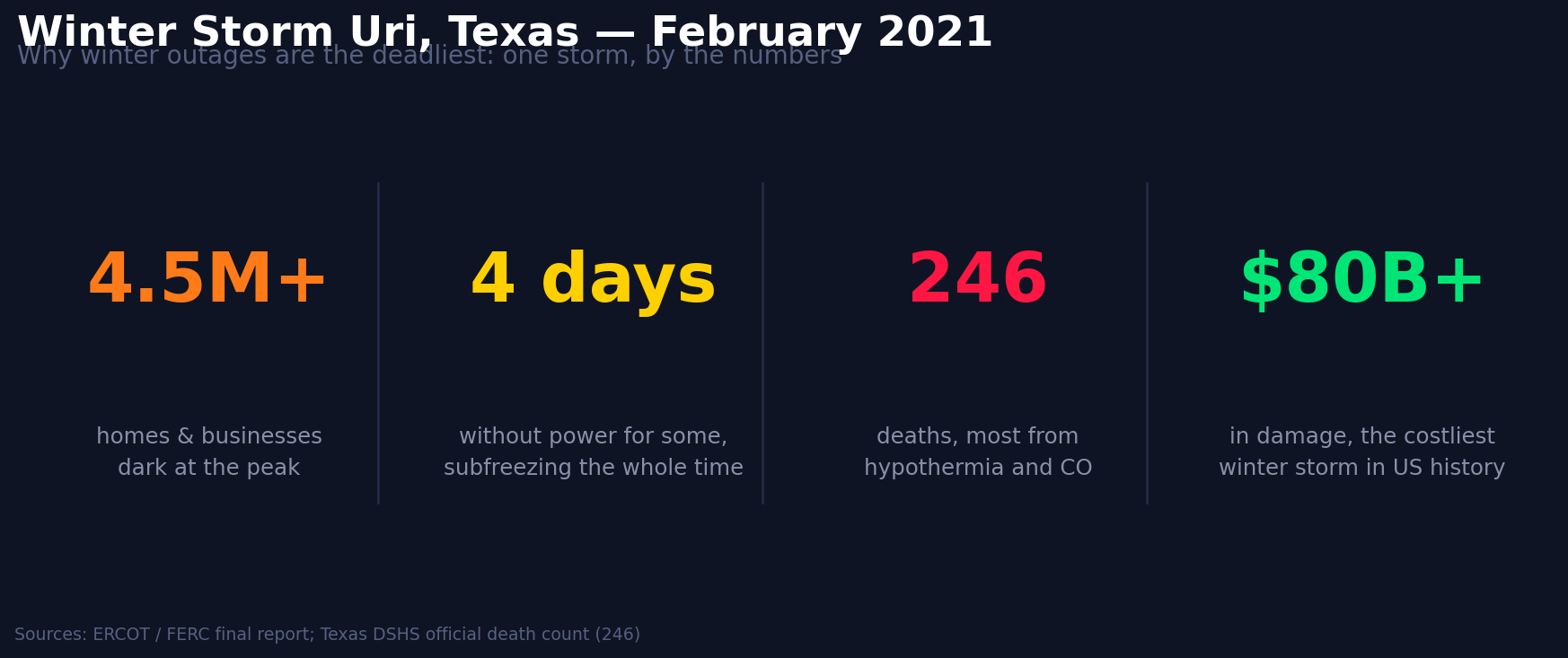
In February 2021, Winter Storm Uri buried Texas in snow and knocked out power to more than 4.5 million homes and businesses—some for four straight days of subfreezing temperatures. The state’s official count: 246 deaths, most from hypothermia. It was the deadliest power-outage disaster in modern American history, and it happened in a state that prides itself on energy abundance.
The lesson wasn’t that Texas is unique. It’s that winter outages kill in ways summer outages don’t. When the power dies in July, you’re uncomfortable. When it dies in January, you’re on a clock—and so are your water pipes. This guide covers what actually matters for a winter storm outage: staying warm, staying alive, and keeping your house from turning into an insurance claim.
New here? Start with the global power outage crisis for the big picture, or see our hurricane outage guide if storms are your concern.
Why Winter Outages Are the Deadliest
Three failure modes make winter outages uniquely dangerous:
1. Hypothermia at home. Indoor temperatures in an unheated house in a hard freeze can drop into the 30s°F within a day. Overnight lows indoors can kill infants and the elderly well before the house “feels” deadly. During Uri, people died in their beds.
2. Carbon monoxide. Desperate for heat, people bring generators indoors, run charcoal grills inside, or heat with gas ovens. CO poisoning spikes after every major winter outage—in Texas 2021, it sent hundreds to hospitals and killed dozens. It’s the most preventable cause of death on this list.
3. Frozen and burst pipes. When your heat is off for 24+ hours in a freeze, water in your pipes freezes, expands, and splits copper and PEX alike. One burst pipe in a wall cavity can dump hundreds of gallons. The insurance bill arrives after the outage is a memory.
Add the grid physics: winter storms coat lines in ice (an inch of ice on a line weighs as much as a foot of wet snow), demand spikes exactly when supply fails, and crews work in conditions that slow everything down. Assume 24–72 hours without power in a serious winter event, and prepare for cold, not just darkness.
Before the Storm: The Winter Prep Kit
A winter kit is a hurricane kit plus cold-weather gear:
- Heat retention: extra blankets, sleeping bags (rated for camping), hand warmers, emergency mylar blankets
- Light: headlamps over flashlights—you need your hands free in gloves (the rechargeable lights guide ranks the cold-house options)
- Food and water: no-cook food; keep some water indoors (garage water freezes)—fridge discard rules in the food-safety guide
- Battery or hand-crank radio plus a charged power bank
- Battery-powered CO detector—non-negotiable if you own any fuel-burning heater or generator
- Pipe insulation (foam sleeves) for exposed runs, installed well before the season
The night before the freeze:
- Drip your faucets (a pencil-thin stream on the coldest tap) — moving water freezes slower
- Open cabinet doors under sinks on exterior walls so house heat reaches those pipes
- Fill the bathtub and stockpots with water for flushing
- Charge everything—including your portable power station to 100%
- Park the car where it’s easiest to clear, fuel above half
During the Outage: Staying Warm and Alive
Pick one room and defend it. Don’t heat the whole house—gather everyone (and the pets) into one small, interior room, ideally on an upper floor (heat rises; ground floors lose to slab and crawlspace). Close every other door. Hang blankets over windows and doorways. You’re building a heat pocket that body heat and safe heaters can actually keep livable.
Layer like you’re camping. Base layer, mid layer, hat, gloves, thick socks. Loose layers trap warm air; tight layers cut circulation. Wear a hat indoors—embarrassment is survivable, hypothermia isn’t.
Eat before bed. Your body burns calories to stay warm overnight. A snack before sleeping is literal fuel for the night.
Never, ever:
- Run a generator, charcoal grill, or camp stove indoors or in a garage (CO has no smell; the “I’ll be careful” crowd is who dies)
- Heat the house with a gas oven or stovetop
- Use a propane heater not rated and vented for indoor use
- Burn anything in a stove or fireplace with a closed or blocked flue
Protect the pipes while the heat is off:
- Keep faucets dripping on the coldest wall
- If a pipe does freeze: keep the tap open, apply heat (hair dryer, heat gun on low) starting at the faucet end, working back. Never use an open flame.
- Know where your main water shutoff is. If a pipe bursts, that valve is your first move.
Backup Power in a Freeze: Do the Math Before You Buy
Winter changes the backup-power math because heaters are hungry:
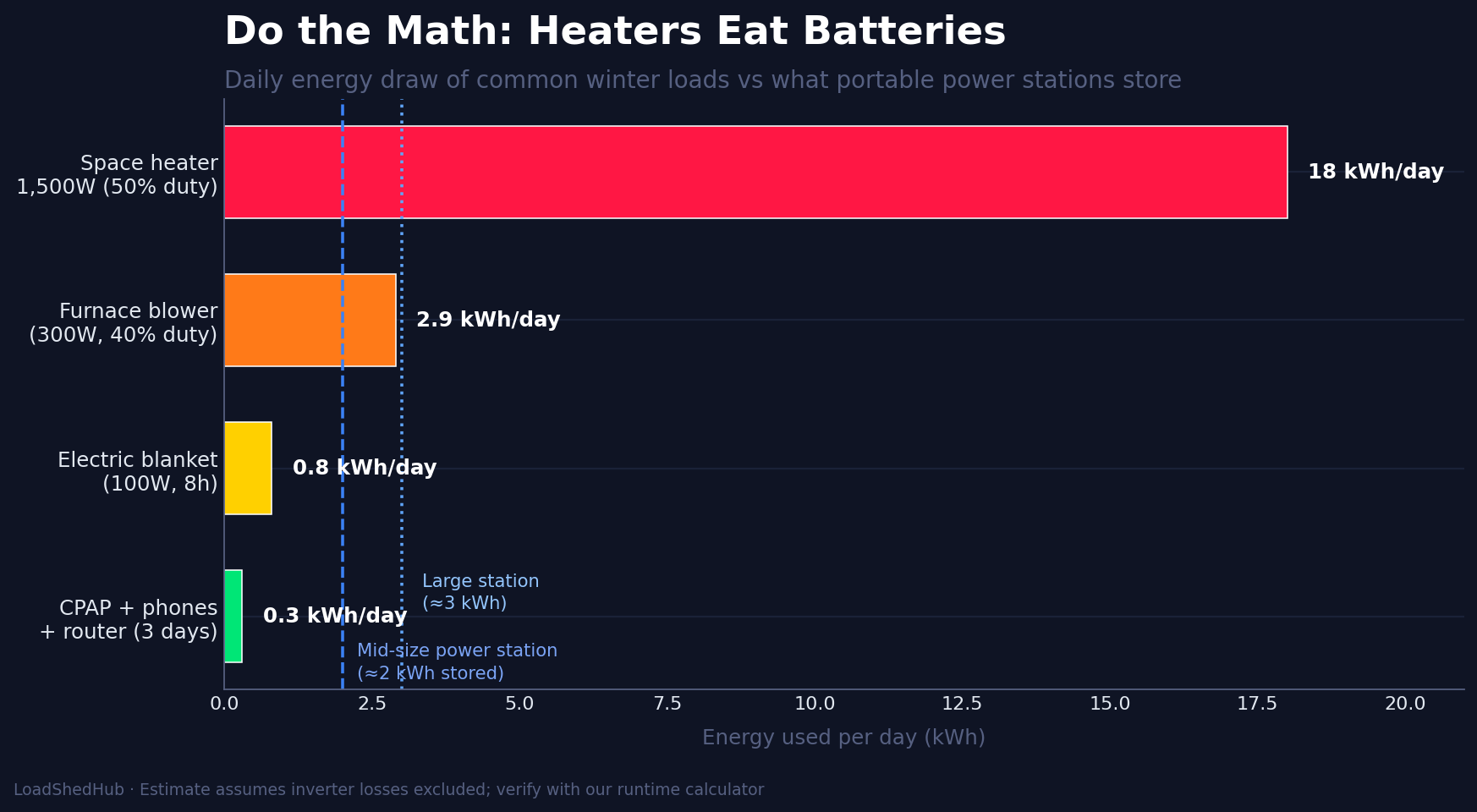
- A 1,500 W space heater running half the time pulls roughly 18 kWh a day—far beyond what a mid-size power station stores
- A gas furnace needs only a few hundred watts for the blower, but furnaces don’t run on batteries without a transfer setup
- A CPAP, phone charging, router, and LED lights for three days: well within reach of a 1,000–2,000 Wh power station
So the honest winter strategy is tiered:
- Power station for the quiet essentials — phones, radios, CPAP, the fridge (winter is on your side: put perishables in a cooler in the garage and nature refrigerates them), and maybe an electric blanket, which draws a fraction of what a space heater does
- Generator or dual-fuel inverter for the big loads — if outages in your region routinely run long, a 3,500 W+ inverter generator can carry a furnace blower, a space heater on low, fridge, and lights. Outdoors, 20+ feet from the house, exhaust away. Always.
- Insulation as infrastructure — the cheapest “backup power” is a house that loses heat slower. Weatherstripping, window film, and an insulated room you can defend cost less than one battery module and pay off every single winter.
Run your own numbers with our runtime calculator, and watch for our gear guides for specific units.
Special Cases
If someone in the house is medically vulnerable (infant, elderly, CPAP, oxygen concentrator): register with your utility’s medical baseline program now—it adds notice priority and sometimes rate protection—and identify the nearest warming center before you need it.
If you’re in an apartment: you can’t defend a room as easily, but the drill is the same: smallest room, blankets over windows, layers, and a power station sized for devices rather than appliances.
If the car is your heat source of last resort: run it in the open, never in a garage or near a snow-blocked tailpipe; crack a window; and keep the exhaust pipe clear of snow. A blocked exhaust can fill the cabin with CO in minutes.
The Bottom Line
Hurricane outages are miserable; winter outages are dangerous. The difference is cold, and cold is a clock: your pipes, your battery, and your body all run down faster than you expect. Do three things before the first hard freeze of the season—build the winter kit, insulate one defensible room, and settle your backup-power plan—and you’ve removed the three ways a winter outage becomes a catastrophe.
Next: hurricane outage prep | complete power outage checklist | power-station sizing calculator