
How Long Does Food Last Without Power? The Fridge & Freezer Safety Guide (2026)
The clock starts the moment the grid drops. An unopened fridge holds a safe temperature for about four hours—that’s the whole budget nature gives your milk, meat, and leftovers. After that, you’re not storing food, you’re incubating it. The freezer is a different animal: packed full, it can hold the line for 48 hours without a watt. Knowing which device you own—a 4-hour box or a 48-hour vault—is the difference between a quiet shrug and a garbage bag full of $300 of groceries. This is the guide.
- Fridge: 4 hours if nobody opens the door. Every opening burns 1–2 hours of that budget.
- Full freezer: 48 hours. Half-full: 24. Thermal mass is armor—a full freezer defends itself.
- The discard rule: perishables (meat, dairy, eggs, leftovers) held above 4°C / 40°F for more than 2 hours cumulative get thrown out. Not cooked. Out.
- Buy the $10 tool: an appliance thermometer in the fridge and one in the freezer turns “I think it’s fine” into a number you can act on.
- Want the fridge itself to survive the outage? A 1–2 kWh power station runs it half a day to a full day—the math is below.
The Clock, Charted
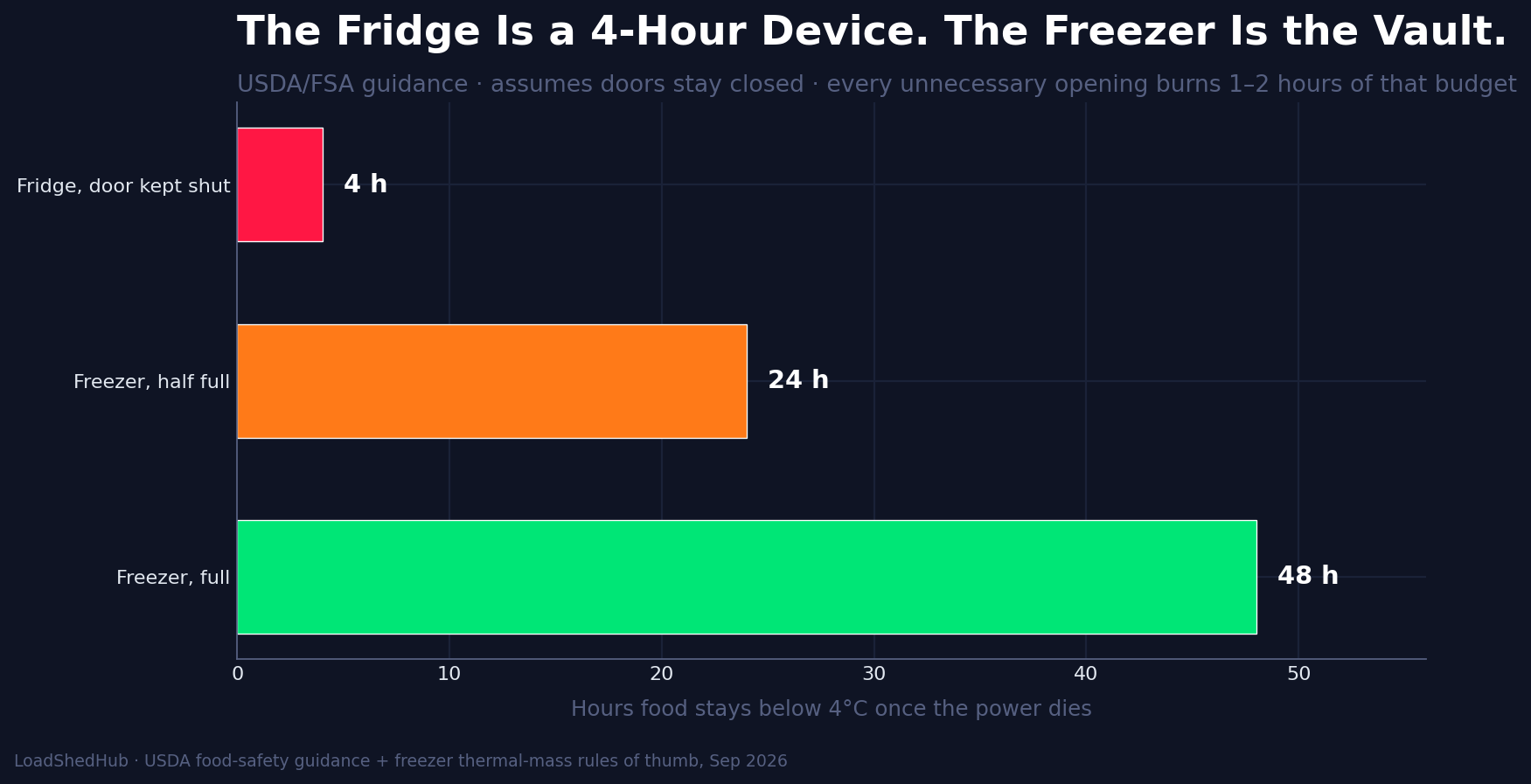
Notice the shape of that chart: it’s not about the fridge’s quality or age. It’s about thermal mass. A freezer full of frozen bricks of food (or frozen water jugs) has hours of cold stored in it; an airy half-empty one loses its buffer to every intrusion of warm air. This is why the prep move is counterintuitive but free: in the days before a forecast outage, fill every gap in your freezer with frozen water bottles. The hurricane guide has this in its 72-hour checklist for exactly this reason.
The Rules of the Clock
- Do not open the fridge “to check.” You are the thermostat’s enemy. Decide what you need, open once, take everything.
- Freeze ahead when you can see the outage coming. Storm forecast, planned load shedding, a PSPS warning—fill jugs, freeze ice packs, move milk to the freezer (it thaws back into fridge-cold food later, buying hours).
- Group food in the freezer. A solid mass of items holds cold far longer than items spread thin with air gaps.
- Keep the fridge at its coldest normal setting before the outage. A fridge running at 2°C enters the outage with more headroom than one at 6°C.
- Dry ice is the emergency lever (about 25 lb / 12 kg holds a full freezer ~2 extra days)—but it’s a hazard in a sealed car and in a small room. Gloves, ventilation, and only if you already know how to handle it.
What to Keep and What to Toss
When power returns, the thermometer decides—not your nose, and not thrift. These are the USDA rules of thumb:
- Toss without sentiment: raw or cooked meat, poultry, seafood, eggs, soft cheese, milk, yogurt, cut fruit, and leftovers that spent more than 2 hours above 4°C / 40°F. Some pathogens don’t announce themselves with smell.
- Keep, usually without risk: butter and hard cheeses, condiments (ketchup, mustard, soy sauce, vinegar-based dressings), whole uncut fruit and vegetables, bread, unopened juices.
- Freezer items: safe to refreeze if they still contain ice crystals or held below 4°C. Quality may suffer; safety doesn’t. A thawed-but-cold frozen dinner is dinner.
- When in doubt, throw it out. The $8 of chicken is not worth the week you lose.
Making the Fridge Itself Outage-Proof
Everything above is damage control. The upgrade is keeping the compressor running through the cut—and a fridge is a friendlier load than its reputation suggests, because it cycles: an efficient modern fridge-freezer averages around 60 W even though the compressor surges to 8–10× that when it starts. That startup surge is the catch: you need a station that can absorb roughly 1,200 W momentarily, which is exactly what the X-Boost-class units in our station guide are built to do.
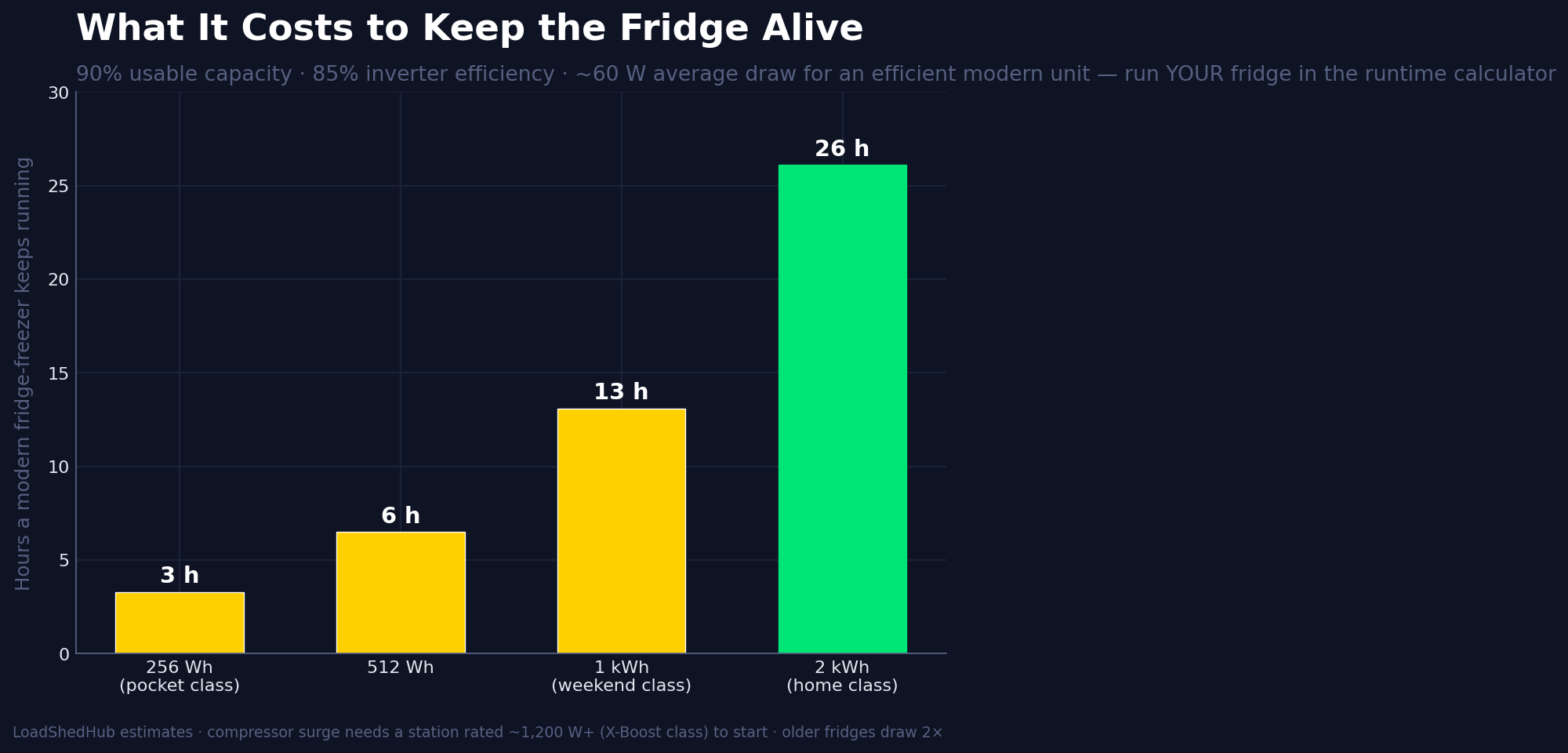
The pattern that emerges: a pocket station barely buys you dinner; a 1 kWh class buys you overnight; a 2 kWh class buys you a day and change of silence. In load shedding country, where outages come in scheduled 2–4 hour blocks, even the small station covers the block completely—the South Africa guide treats the fridge as the second rung of the ladder after the essentials checklist.
Two Scenarios, Two Playbooks
The scheduled or short outage (load shedding, PSPS, rolling cuts): doors shut, freezer full, thermometer watched. Most fridge contents ride through a single 4-hour block untouched; back-to-back blocks are what erode the budget.
The storm multi-dayer (hurricane, ice storm): the freezer is your bank—stock it before landfall, open it once a day at most, and either run the fridge off a station in shifts or consolidate everything into coolers with the freezer’s ice. The hurricane timeline and the winter storm guide both fold food strategy into the bigger picture, because in a storm the fridge competes with heat, light, and medical devices for your battery budget.
The Bottom Line
Food safety math is unusually fair: the actions are free (don’t open the door, fill the freezer, own a $10 thermometer), the thresholds are known (4 hours / 40°F / 2-hour discard rule), and the upgrade path is priced (a 1 kWh station turns the fridge from a 4-hour device into an overnight survivor). Do the free things tonight; size the battery when you’re ready—and put the whole household plan together in the complete outage checklist.
Next: the complete outage checklist | best portable power stations | runtime calculator | hurricane power outage prep