
Nigeria’s Power Crisis: Grid Collapses, Generators, and How to Cope
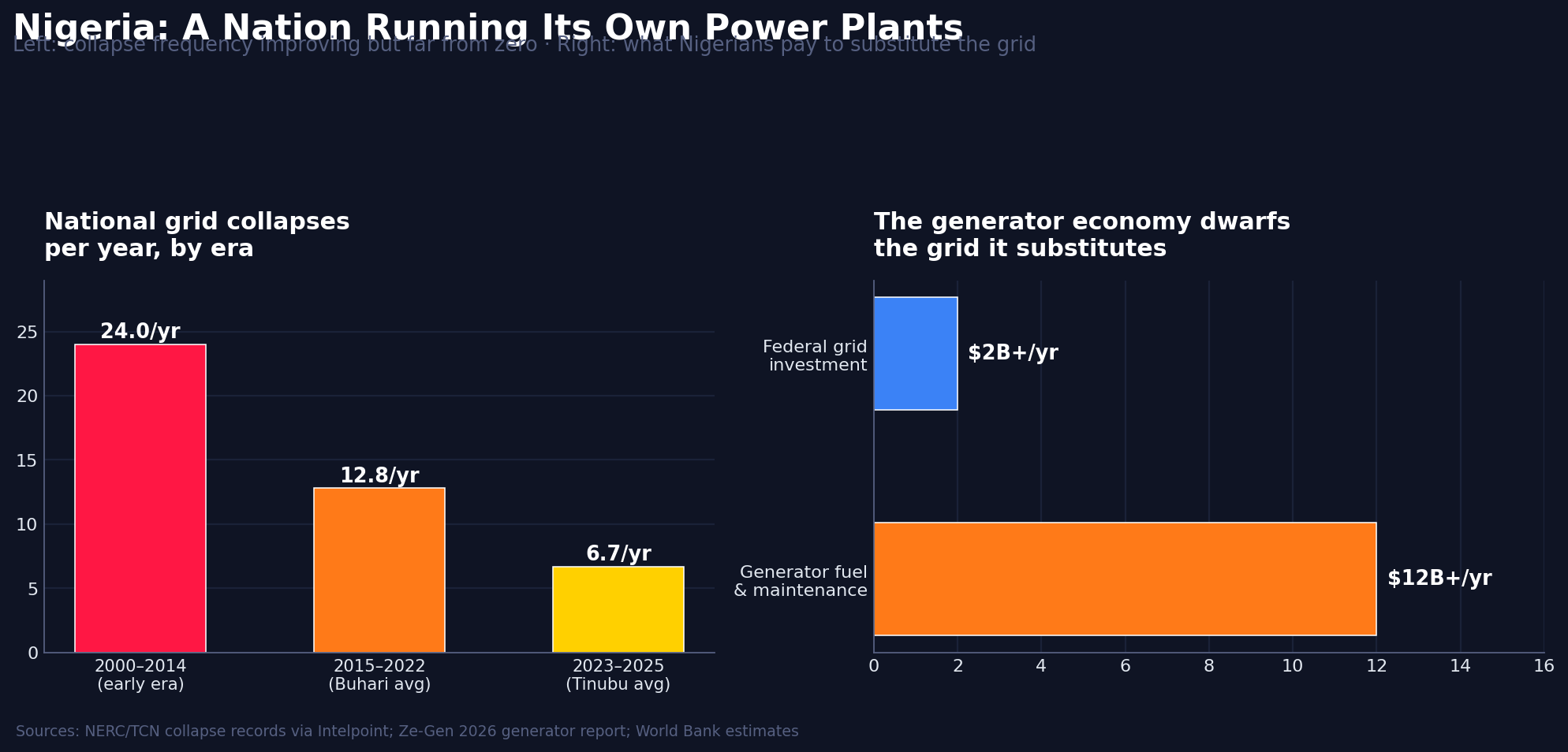
On January 23, 2026, at about 12:40 p.m., Nigeria’s national grid collapsed. Every one of the country’s 11 distribution companies went dark at once. Four days later, it did it again. These weren’t rare events—they were entries in a ledger that has recorded over 560 total or partial grid collapses since 2000, an average of more than two every month for a quarter century.
Nigerians have a name for the whole situation: “NEPA”—the initials of the old National Electric Power Authority, now a national shorthand for anything unreliable. “NEPA will take the light.” The joke is fifty years old and still current, because the underlying condition is.
This guide explains why the grid keeps failing, what the world’s largest generator economy actually costs, and what backup options make sense in Nigeria in 2026. For the continental context, see our South Africa load shedding guide and the global picture.
Why the Grid Keeps Collapsing
Nigeria’s problem isn’t generation alone—it’s a chain of weaknesses:
- A transmission grid built for 1960s demand. Much of Nigeria’s transmission backbone dates to the decades after independence; it moves a fraction of what the country needs. Generation has grown; the wires haven’t.
- Gas supply problems. Most Nigerian plants burn gas; pipeline vandalism, payment disputes, and underinvestment make fuel supply erratic—plants trip, and the grid loses generation suddenly.
- Manual grid control. For years, grid operators balanced the system substantially by phone and human coordination rather than modern automation. When frequency swings, humans react in minutes; modern grids react in milliseconds.
- The math of insufficiency. Over 78% of customers receive less than 12 hours of supply a day; the World Bank’s benchmark for “unreliable grid” is about seven outages a week averaging 12 hours.
When any link trips, the whole national system—operating with almost no margin—collapses like a line of dominoes, dropping from thousands of megawatts to nearly zero within an hour.
The Generator Economy: What It Actually Costs
Nigeria runs on the world’s largest fleet of small generators. The numbers are staggering (the full fuel-vs-battery trade-off is in our generator vs power station comparison):
- ~40% of households own a generator—roughly 40 million machines, from 1 kVA petrol “I pass my neighbor” units to industrial diesels
- $10–14 billion a year spent on generator fuel and maintenance—more than the federal government invests in the grid
- Generators produce roughly 40% of Nigeria’s CO2 emissions—a country whose transport and industry are dwarfed by the exhaust of its backup power
- The noise and fumes are a national soundscape: every street, every market, every office running its own private power plant
The bitter economics: grid electricity, when it comes, is cheap. The generator is what you pay for the grid’s absence—and petrol at ~₦700/litre and diesel at ~₦1,250/litre make that absence brutally expensive.
The New Playbook: Batteries Are Eating the Generator
For fifty years the generator was the only answer. That’s changing, and the direction matters for every Nigerian household and business:
1. Lithium inverter + battery for the daily gap. Nigeria’s outages are frequent but often short—the exact profile that favors batteries over fuel. A 1–2 kWh lithium inverter system runs lights, fans, TV, Wi-Fi, and phones silently through typical outages, recharges when the grid returns, and costs nothing per cycle. It doesn’t replace the generator for AC or heavy loads—it removes the generator from 80% of your day. (Sizing guide: inverters for load shedding.)
2. Solar as the generator’s replacement, not the grid’s. Nigeria sits on some of the best solar resource in the world. Panels + battery means your “grid” is the sky: no fuel line, no diesel price, no noise. Businesses led this shift—telcos replaced diesel sites with solar-battery hybrids years ago—but household systems are now affordable enough to compete with generator fuel within a few years of ownership.
3. Keep a small generator for the big stuff. The pragmatic Nigerian stack in 2026: inverter-battery for the daily rhythm, small generator for AC days and heavy-duty moments, solar panel to shrink the fuel bill further. Each layer removes hours of generator runtime.
4. Protect what plugs in. Grid-return surges after a collapse kill electronics. Surge protectors on TVs and routers are cheap; whole-house protection is cheaper than one fried TV. And register with your DisCo—complaint volume is one of the few levers customers have.
If You’re Visiting or Moving to Nigeria
- Expect outages daily; ask any hotel or rental about their backup (good ones have seamless inverters or generators—often both)
- A power bank and a charged laptop battery are daily-carry items
- Noise at night is usually generators, not traffic
The Bottom Line
Nigeria’s power crisis is structural, generational, and—notwithstanding official improvement claims—ongoing: the grid collapsed twice in the first month of 2026 alone. But the coping playbook has genuinely evolved. The generator economy built over fifty years is now being undercut by lithium batteries and solar, exactly as they undercut South Africa’s load shedding. The country that perfected living without reliable grid power is quietly becoming the world’s lab for living beyond it.
Import duties make global brands expensive here; the practical local play is an inverter + battery bank, widely listed on Jumia with local sellers and support.
Next: South Africa load shedding guide | inverter sizing | runtime calculator | the global crisis