
Best Inverters for Load Shedding (2026): Trolleys, Batteries, and Sizing
In most of the world, backup power means a “portable power station.” In South Africa, it means an inverter trolley—a wheeled box holding an inverter and one or more batteries, charged from the wall between outages and rolled to wherever it’s needed. Fifteen years of load shedding built this category, and it’s worth understanding even if you eventually buy something else—because the trolley market teaches the two lessons every backup-power buyer needs: battery chemistry matters more than the sticker, and sine wave quality is not optional.
New to the topic? Start with our complete South Africa load shedding guide for the current 2026 picture.
Lesson One: Lithium, Not Gel (This Is the Big Mistake)
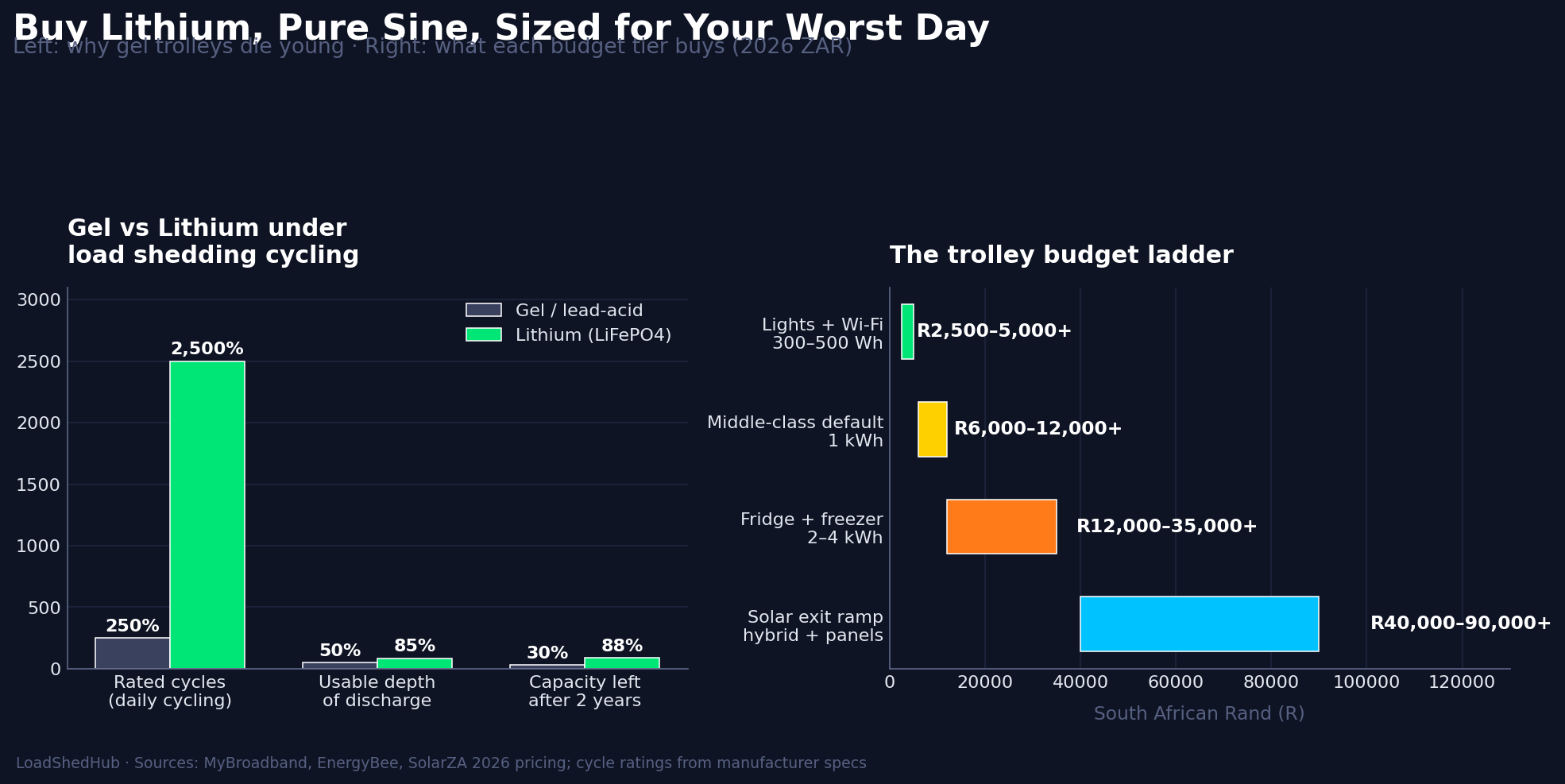
Walk into any hardware store and you’ll see trolleys at tempting prices running gel or lead-acid batteries. Here’s what the sticker doesn’t say: gel batteries are built for occasional standby use. Under load shedding’s daily deep cycling, they degrade fast—a few hundred cycles at best, and many South Africans discovered their “bargain” trolley was losing half its capacity within two years.
Lithium (LiFePO4) changes the math: 2,000+ cycles, much deeper usable discharge (you can use 80–90% of the rating vs gel’s ~50%), lighter, and cheaper per cycle despite the higher sticker. The South African market has decisively shifted to lithium for exactly this reason. Pay the extra R2,000–4,000 for lithium once, or pay for a whole new gel trolley in two years. That’s the whole lesson.
Lesson Two: Pure Sine Wave, Always
The inverter’s job is turning battery DC into wall-style AC. Cheap ones output a “modified sine wave”—a choppy approximation that’s fine for a drill but slowly damages TVs, routers, laptops, and anything with a modern power supply. The rule South Africans learned the hard way: if it will power electronics, it must be pure sine wave. Every recommendation below qualifies.
Trolley vs Portable Power Station
| Inverter trolley | Portable power station | |
|---|---|---|
| What it is | Separate inverter + battery in a wheeled frame | All-in-one sealed unit |
| Replace/upgrade battery | Yes, separately | No (buy a bigger unit) |
| Price per kWh | Lower | Higher |
| Convenience | Charge, roll, plug | Charge, carry, plug — plus USB ports, apps, UPS switching |
| Best for | Frequent long outages, tinkerers, fridge duty | Devices-first users, occasional outages |
South Africa’s answer to load shedding was mostly trolleys because outages were frequent, long, and fridge duty mattered. As outages got shorter (and the global brands arrived), power stations took the convenience crown. Both are correct answers to slightly different questions.
What to Buy, by Budget (2026)
Lithium and pure sine wave only — the two lessons above. Local trolley brands ship fast from Takealot stock; the global station brands run South African stores with local warranty:
R2,500–5,000 — the lights-and-WiFi tier. 300–500 Wh lithium trolleys (or entry power stations) run routers, phones, LED lights, and a TV through a typical Stage 2–4 slot. This is the “stay connected” floor, and it’s cheap insurance.
R6,000–12,000 — the middle-class default. 1 kWh-class lithium trolleys (e.g., 1kW units like the Kool Energy trolley at ~R9,999) or imported 1 kWh power stations. This tier carries TV + Wi-Fi + lights + laptops and survives an evening fridge slot. For most South African households, this is the sweet spot—the capacity load shedding actually demanded.
R12,000–35,000 — the fridge-and-freezer tier. 2–4 kWh: whole-evening fridge duty, multiple rooms of lights, the TV, the coffee machine. Trolleys here are modular (add a battery later); premium power stations here add solar input and app control.
R40,000+ — the exit ramp. Fixed hybrid inverter + lithium bank + solar: you stop participating in load shedding altogether and cut your Eskom bill while you’re at it. This is the upgrade path the solar industry grew rich on. (See our take in the load shedding guide.)
Sizing: The Two-Question Method
1. What must stay on? Wi-Fi + phones + TV + lights ≈ 300–500 Wh per outage slot. Add a fridge, roughly double it. Add a freezer, double again.
2. How many slots per day at your worst stage? Stage 4 ≈ 2–3 slots; Stage 6 ≈ 4+. Size the battery for worst-stage day, then let the wall outlet recharge it between slots—which is exactly what lithium chemistry is built for.
For exact numbers on your specific devices, our runtime calculator does the math in 30 seconds.
The Bottom Line
The South African playbook, compressed: lithium, pure sine, size for your worst day. A 1 kWh lithium trolley or power station covers what Stage 4 actually takes from you; gel anything is a two-year mistake; and if outages ever return at scale, the R40,000 solar exit ramp stops being an indulgence and starts being an investment. Fifteen years of load shedding wrote this checklist—the rest of the world is just now learning to read it.
Next: South Africa load shedding guide | runtime calculator | best portable power stations