
PSPS Explained: Why California Turns Your Power Off on Purpose
It’s a warm October evening in Northern California. The wind is howling, humidity has crashed into the single digits, and your power just went out—along with two million of your neighbors’. There’s no storm damage. No accident. The utility shut you off on purpose.
It’s called a Public Safety Power Shutoff (PSPS), and if you live in California (or parts of Oregon, Nevada, and a growing list of states), it’s a fact of life you need to understand—because unlike every other outage type we cover, this one comes with a forecast. New here? See the global picture first.
What a PSPS Is—and Why It Exists
After the devastating 2017 North Bay fires and the 2018 Camp Fire—the deadliest in California history, ignited by a PG&E transmission hook—utilities faced a brutal choice. Their aging equipment, stressed by extreme wind, could spark the next catastrophe. So California’s utilities got permission to do something once unthinkable: de-energize whole regions before the fire risk peaks.
The logic: a power line can’t start a fire if it carries no electricity. The cost: hundreds of thousands of people—hospitals, groceries, home businesses, and everyone else—lose power for a day or more, in a state where “windy and dry” is a weekly forecast each autumn.
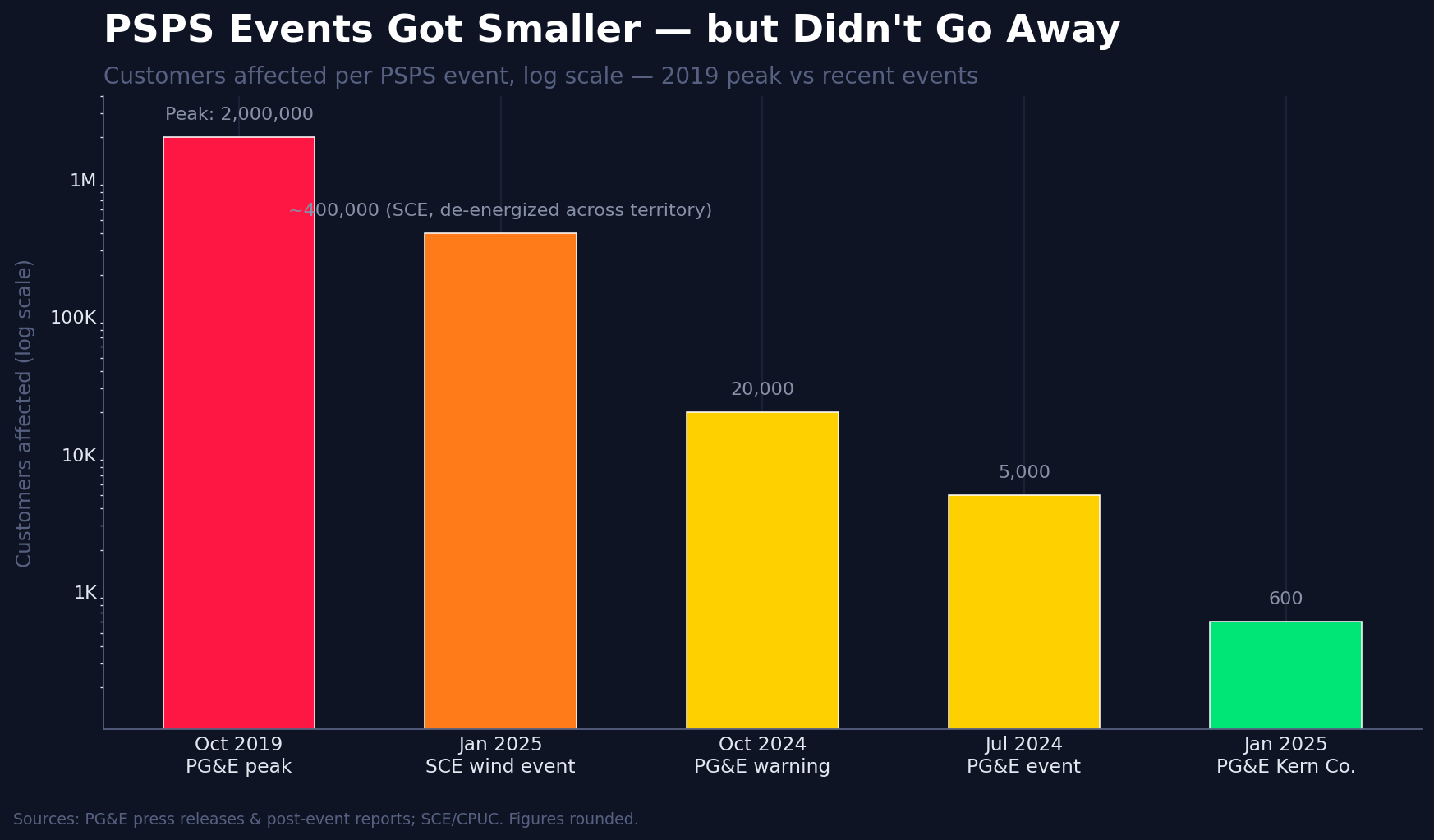
Peak PSPS: October 2019, when PG&E alone cut roughly 2 million customers in a series of events that made national news and pushed the state to rewrite the rules.
What’s Changed Since 2019
The good news is that PSPS events have gotten dramatically smaller. Utilities have spent billions on:
- Sectionalizing devices that let them switch off a few hundred homes instead of a whole circuit
- Weather stations and HD cameras on towers, giving sharper go/no-go calls
- Undergrounding and insulated wire in the highest-risk zones
So the typical PSPS today touches thousands of customers, not millions—often just a few hundred in one county. But the mechanism hasn’t gone away. In January 2025, during the Santa Ana windstorms that fed the Eaton and Palisades fires, Southern California Edison cut power to large parts of its territory on exactly this logic. If you live in a high fire-threat district, PSPS is a permanent feature of autumn.
What Triggers a PSPS—and Will It Hit You?
Utilities watch a short list of conditions, and when several stack up, they pull the trigger:
- Red Flag Warning from the National Weather Service (the official “fire weather” alarm)
- Sustained winds strong enough to throw branches and debris into lines (often 40+ mph gusts in your area’s forecast)
- Extremely low humidity (often below 15–20%) plus dry vegetation
- On-the-ground observations from their own weather network and field crews
Find out if you’re in a PSPS zone: PG&E, SCE, and SDG&E all publish address-lookup tools and high fire-threat district maps. If your address shows up, bookmark your utility’s outage page and enroll in alerts now—the notices typically arrive 24–48 hours before shutoff.
How Long a PSPS Lasts
The typical timeline:
- 48h before: watch/warning notice; crews move into position
- 24h before: confirmation notice for affected addresses
- Shutoff: power cut as wind peaks—often early morning, always “as long as the risk lasts”
- Patrols: after winds drop, crews must visually inspect every line by air and ground before re-energizing (a line damaged overnight can’t just be switched back on)
- Restoration: typically within 24–48 hours of winds dying—so total outages often run 12 hours to 3 days
That patrol step is why PSPS outages don’t end when the wind does. Plan for at least one night dark, possibly two.
How to Prepare for a PSPS
Before the season (May–September):
- Check your address on your utility’s fire-threat map; register for alerts
- Battery backup for essentials — this is the single best PSPS investment. Unlike hurricane zones, you don’t need to run a fridge for a week; you need phones, Wi-Fi (or a hot spot), medical devices, and maybe the garage fridge overnight. A 1,000–2,000 Wh portable power station covers almost every PSPS scenario. (Gear guide coming soon.)
- If you rely on a well pump, medical equipment, or an elevator: your utility’s medical baseline program adds notice priority—register in advance
- Consider surge protection—power returns in waves as circuits are switched
When the notice comes (24–48h out):
- Charge everything: power station, phones, laptops, EV (yes, to 100%)
- Fill some water containers if you’re on a well pump
- Do the shopping and laundry now
- Gas up the car and know how to open your garage door manually
- Freeze ice packs; set fridge and freezer to coldest
During the shutoff:
- Fridge closed = ~4 hours safe; full freezer = ~48 (same food rules as any other outage)
- Keep one phone as “radio” on low-power; use the other for essentials
- Check the utility’s restoration map—PSPS re-energization is published street by street
- Never run a generator in a garage; PSPS wind events mean your CO risks are identical to any other outage
PSPS vs. Every Other Outage
| PSPS | Hurricane / storm | |
|---|---|---|
| Warning | 24–48h, address-level | Days, region-level |
| Cause | Deliberate (fire prevention) | Damage |
| Typical duration | 12h–3 days | Hours–2 weeks |
| Best prep | Alerts + power station | Kit + fuel + power |
The irony of PSPS: it’s the only outage where the grid works perfectly the whole time. Your house is fine, the lines are fine—the utility is buying insurance against a fire that hasn’t started. That’s worth remembering when it’s frustrating: the alternative, some years, is Paradise, California.
The Bottom Line
You can’t stop a PSPS, but you can defang it. Register for alerts, know your address’s risk, keep a right-sized power station charged, and treat each shutoff like a planned camping night rather than an emergency. And if the wind-driven blackouts of autumn have you thinking about bigger backup power, our hurricane guide covers generators, and our sizing calculator will tell you exactly what to buy.
Next: hurricane outage prep | winter storm outage prep | best portable power stations (coming soon)