
Pakistan & India Load Shedding: The World’s Biggest Outage Theater
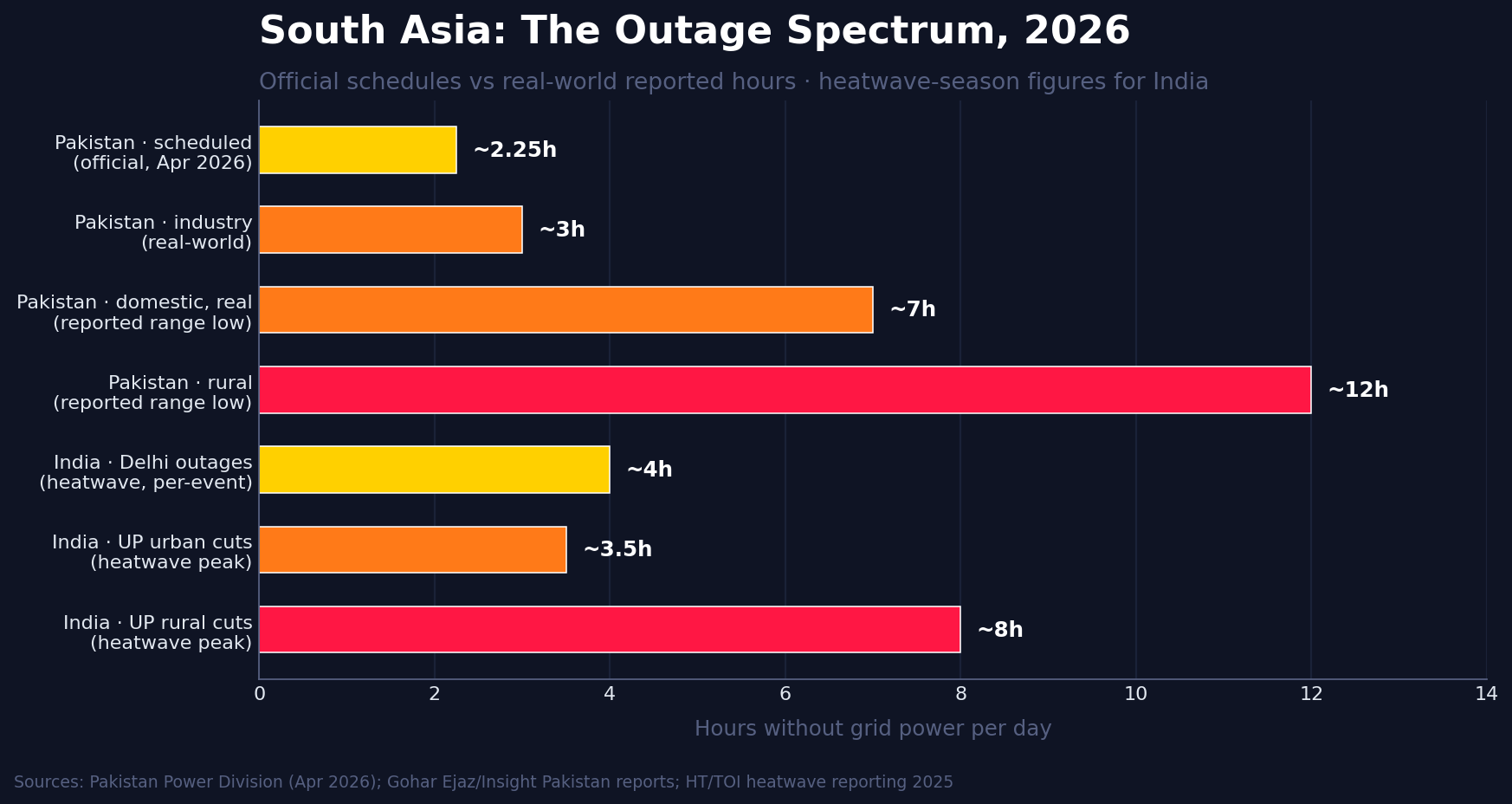
South Asia is the world’s largest load shedding theater. In April 2026, Pakistan’s Power Division announced scheduled nationwide cuts of about 2¼ hours daily during evening peak—while real-world reports put domestic consumers at 7–16 hours, and rural areas at 12–17. India’s grid is far stronger, but the June 2025 heatwave—with peak demand near 273 GW—still delivered 1–8 hour cuts across Delhi, UP, and beyond.
Two countries, one pattern: gaps between supply and demand that surface as scheduled (and unscheduled) outages, in the world’s hottest inhabited plains, for over two billion people. This is the guide. For the concept and vocabulary of load shedding, see our South Africa guide and Nigeria’s version.
Pakistan: Scheduled Scarcity
Pakistan’s crisis is financial before it’s electrical: the country often can’t pay for the fuel its plants need, so capacity exists but doesn’t run. The result is load shedding as fiscal policy—officially announced cuts (the April 2026 schedule ran 5 p.m. to 1 a.m.), plus “load management” that stretches hours in areas with high line losses and low bill recovery. Urban industry reports 2–4 hours; households 7–16; rural feeders the most, partly as loss-reduction enforcement.
Coping culture: UPS units are near-universal in middle-class homes (small battery bridges for the scheduled hours), generators for those who can run them, and a solar boom driven by economics more than idealism—solar-plus-battery now beats the combination of bills, generator fuel, and UPS batteries over its lifetime. Net metering made rooftop PV one of the best investments a Pakistani household can make.
India: A Strong Grid with Heatwave Seams
India’s story is the opposite of Pakistan’s: massive generation buildout, one of the world’s largest single grids, and genuine reliability—right up until a June heatwave pushes demand past 270 GW. Then the seams show: 1–8 hour cuts in Delhi during the 2025 summer (with political fights over whether they were “planned”), 3–4 hour urban cuts and 8-hour rural cuts in UP, and states quietly shedding load while insisting they aren’t. The rural/urban gap remains the reliable pattern.
Coping culture: inverters as the national default (the “inverter battery” is a standard appliance category in Indian homes), gensets for commerce, and a government solar push (PM Surya Ghar) putting subsidized rooftop PV on millions of homes.
The Playbook (Both Countries)
1. The inverter-battery is the appliance, not the accessory. South Asia’s outage profile—daily, scheduled, hours-long—is exactly what inverter systems are built for. A 1–2 kWh lithium unit runs fans (essential, not optional, in 45°C heat), lights, router, and TV through a typical slot. Our inverter sizing guide translates; the runtime calculator does your specific math.
2. Treat heat as the primary threat, not darkness. A South Asian outage is a heat event first. Priorities invert versus the Western playbook: fans and water circulation outrank fridges; a charged rechargable fan is the single highest-value ~$30 item; keep oral rehydration salts stocked. Never run a generator indoors—CO deaths spike in every heatwave season.
3. Solar beats the schedule. If outages are certain and daily, panels turn your battery from a bridge into a substitute. Pakistan’s net-metering economics and India’s subsidy schemes both push the same direction: rooftop PV + battery = you stop caring about the timetable.
4. Battery chemistry, again. The old tubular lead-acid inverter battery needs watering, dies in 2–3 years of daily cycling, and costs more per cycle than lithium. The market is shifting; when your old battery dies, replace the chemistry, not just the unit.
5. Voltage stabilizers and surge protection. South Asian grid power doesn’t just disappear—it also arrives badly (voltage sags and swells). A stabilizer on the fridge and good surge protection everywhere is standard practice for good reason.
The Bottom Line
South Asia’s load shedding is structural—fiscal in Pakistan’s case, capacity-seam in India’s—and no household fixes a national grid. What a household does is convert the outage from a daily disruption into a background hum: an inverter for the rhythm, solar for independence, fans and water for the heat, and lithium when the old battery dies. Two billion people have refined this playbook; this site exists to export it.
India: EcoFlow and BLUETTI sell through Amazon.in with local warranty. Pakistan: Daraz lists inverters and stations — read warranty terms carefully, imported units vary.
Next: South Africa load shedding guide | Nigeria’s power crisis | inverter sizing | runtime calculator | the global picture