
Best Solar Generators for Outages (2026): Turn Daylight Into Runtime
A “solar generator” is really two things: a portable power station (the bucket) plus solar panels (the faucet). What makes the combo special during an outage is one word: refueling. A battery alone is dead when it’s empty. A battery with panels drinks daylight every day the sun rises—no fuel lines, no generators running at 2 a.m., no carbon monoxide anywhere near your bedroom.
This guide covers what most buyers get wrong: how much panel you actually need, what cloudy skies really do to production, and which kits are worth it in 2026.
- Best kit for most families: EcoFlow Delta 3 Max (2,048 Wh) + 400 W panel, ~$1,199 — fridge + network for a day, refilled by the sun
- Budget entry: any 1 kWh station + one 200 W panel, ~$600–800 total
- Whole-home serious: DELTA Pro 3 + 2×400 W panels, ~$3,300+
- The one rule: size panel watts to your worst-season daily draw — winter sun-hours are half of summer’s
The Math: How Much Panel Do You Need?
Solar panels don’t produce their rating—they produce their rating at noon, on a clear day, angled at the sun. Real-world rules:
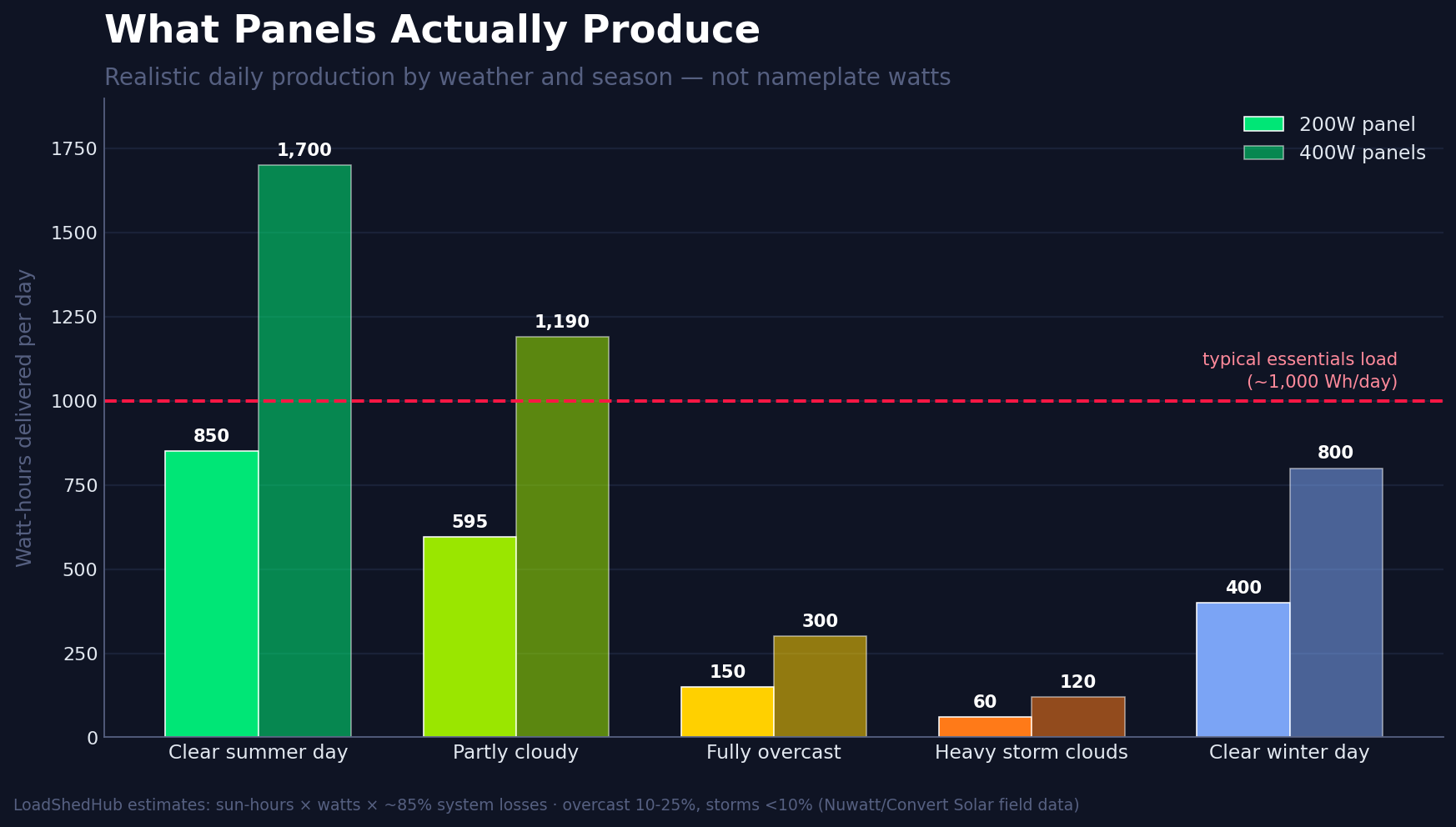
- A 200W panel delivers roughly 600–900 Wh on a good day (4–5 sun-hours × 200W × system losses)
- Fully overcast: 10–25% of that—20 to 50 Wh from the same 200W panel. Heavy storm clouds: under 10%. Partly cloudy is surprisingly decent: 50–80%.
- Winter shortens the faucet. December days in the northern U.S. might give 2 sun-hours; June gives 6. Size for your worst season, not your best.
Now the key insight most guides skip: during an outage, your station doesn’t need to run everything—it needs to cover your daily deficit. If your essentials burn 1,000 Wh/day and you have a 1 kWh station, you need panels that reliably deliver ~1,000 Wh/day. A single 200W panel is marginal (great June, thin December); 400W covers most of the continent year-round for an essentials-only load.
Solar Generator vs. Gas Generator: The Honest Table
| Solar generator | Gas generator | |
|---|---|---|
| Refuel | Free, daily (weather-dependent) | Fuel runs; gas stations need power to pump |
| Noise | Silent | 55–70 dB |
| Indoor-safe power | Yes (battery indoors, panels out) | Never indoors/garage; CO risk |
| Sustained big loads (AC, well pump) | Needs huge battery | What it’s built for |
| Multi-week outage | Solar wins (sun keeps coming) | Depends on fuel access |
| Upfront cost | Higher ($800–3,000+) | Lower ($500–1,500) |
The playbook for storm country: battery runs the quiet essentials overnight; panels and (if needed) a small inverter generator cover the day. See our hurricane guide for that hybrid drill.
The Kits Worth Buying (2026)
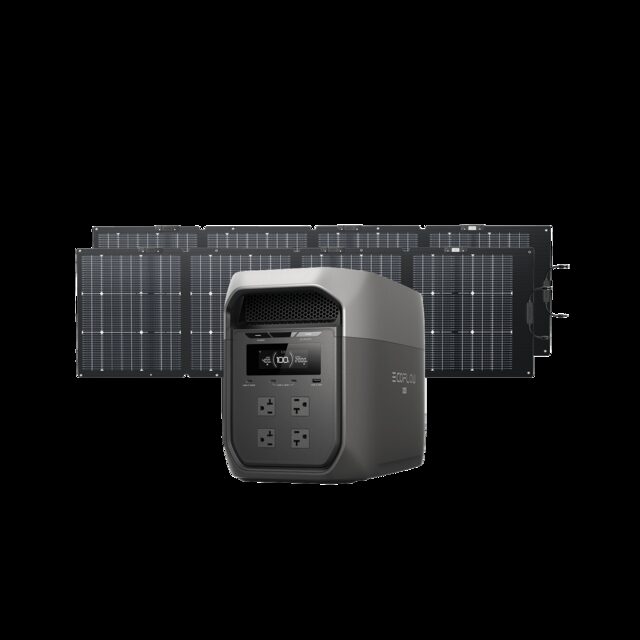
Budget tier: pair any 1 kWh station from our station guide with one 200 W panel. Regional buttons open official stores for your country.
Best for most families: EcoFlow Delta 3 Max (2,048 Wh) + 400W panel — ~$1,199 street
The balanced kit. 2 kWh runs a fridge + freezer + network for ~24 hours; the 400W panel refills most of that daily, even with a cloudy morning mixed in. 2,000W output handles startup spikes without drama. If you buy one kit for storm country, this is the shape of it.
Budget entry: any 1 kWh station + 200W panel — ~$600–800 total
The Jackery Explorer 1000 v2 or BLUETTI Elite 100 V2 plus one 200W panel gets you the self-refueling loop for the price of the station alone at the next tier. You give up same-day full recharges in winter; you keep the essentials alive indefinitely in three seasons.
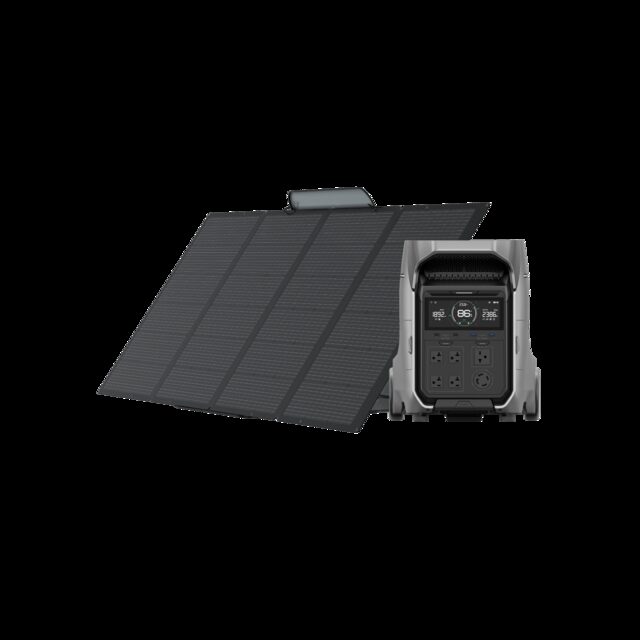
Whole-home serious: EcoFlow DELTA Pro 3 (4 kWh+) + 2×400W panels — ~$3,300+
800W of panel recharges 4 kWh on a single clear day; the Pro 3’s 240V output runs well pumps and HVAC starts; and the battery expands to 48 kWh if your ambitions do. This is the tier where “outage prep” quietly becomes “energy independence.”
Panel notes: prefer the brand’s own panels for guaranteed connector compatibility and warranty coherence; third-party panels work fine if connectors match, but you’re the warranty integrator. Bifacial portable panels (EcoFlow, BLUETTI) pick up 5–15% extra from reflected light—meaningful on concrete, marginal on grass.
What About Winter Outages?
Solar in winter is weaker—shorter days, lower sun angle, possible snow cover—but not zero: expect 2–3 sun-hours on clear winter days in most of the U.S. For a winter-storm strategy, pair panels with a bigger battery buffer (charge to 100% before the storm arrives, run essentials down slowly, let panels top up what they can between storms). The full winter playbook is in our winter outage guide.
The Bottom Line
A solar generator is the only backup power that gets stronger the longer an outage lasts—every sunrise is a delivery. Size the battery to your essentials (our station guide or our runtime calculator), then add panel watts until your worst-season daily production covers your daily draw. Get that ratio right and “how long will the power be out” stops being a question you need answered.
Next: best power stations | runtime calculator | hurricane prep | winter prep