
Best Rechargeable Lights for Load Shedding and Power Cuts (2026)
Every load shedding country has the same tombstone statistics: house fires in the dark, from candles and paraffin lamps tipped by children, pets, and wind. Flame was the only answer when a blackout meant scrambling through a drawer; it was never a good answer. A modern rechargeable LED turns the entire problem into a $15 purchase that silently tops itself up between outages and delivers hours of room-filling light per charge. Lighting is the cheapest square meter of outage preparedness that exists—cheaper than keeping the router alive, and that one’s nearly free already. This is the guide.
- The load shedding starter kit: one rechargeable LED bulb per lived-in room (~$10–20 each / R150–250). Screw it in where the dead bulb is; it charges itself between cuts and gives 3–6 h of normal room light every time the grid drops.
- Add one good lantern (~$25–40) for the kitchen table: 30+ hours on low, charges your phone off its own battery.
- Own a power station already? You don’t need any of this—any USB light turns it into a floor lamp for a week.
- Retire candles and paraffin completely. The 5-year math below shows flame lighting costs 20–30× more than one LED lantern—while burning your house down as a bonus risk.
- The one spec that matters: watt-hours of battery, not “high lumens” claims. 150 lm is plenty to live by; 1,000 lm is a searchlight that drains 5× faster.
What One Charge Actually Buys You
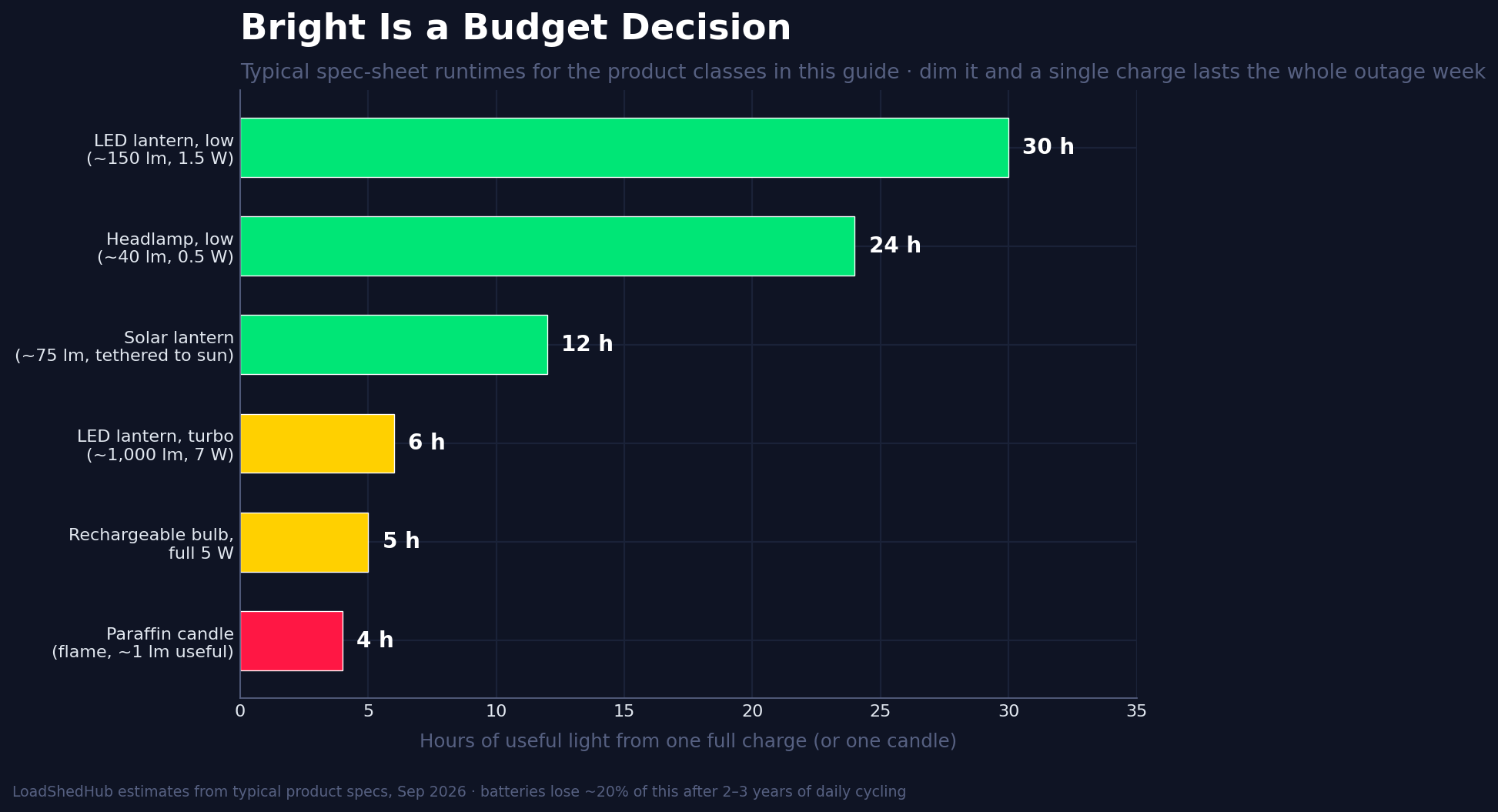
Read that chart as two different products. The low-mode column (lantern at ~150 lm, headlamp at reading brightness) is effectively “days of light per charge”—these are the modes you actually live in during load shedding. The turbo column is for finding the fuse box or cooking a storm dinner: brilliant, brief, rationed. The candle, for contrast, delivers barely one lumen of useful light and does it with an open flame.
Flame Lighting Is a Tax
The candle-vs-LED argument is usually made on safety. It shouldn’t be—the money alone settles it. A household lighting 5 outage-hours a night, 260 nights a year (an ordinary stage-3 year in South Africa, or a normal Nigeria existence):
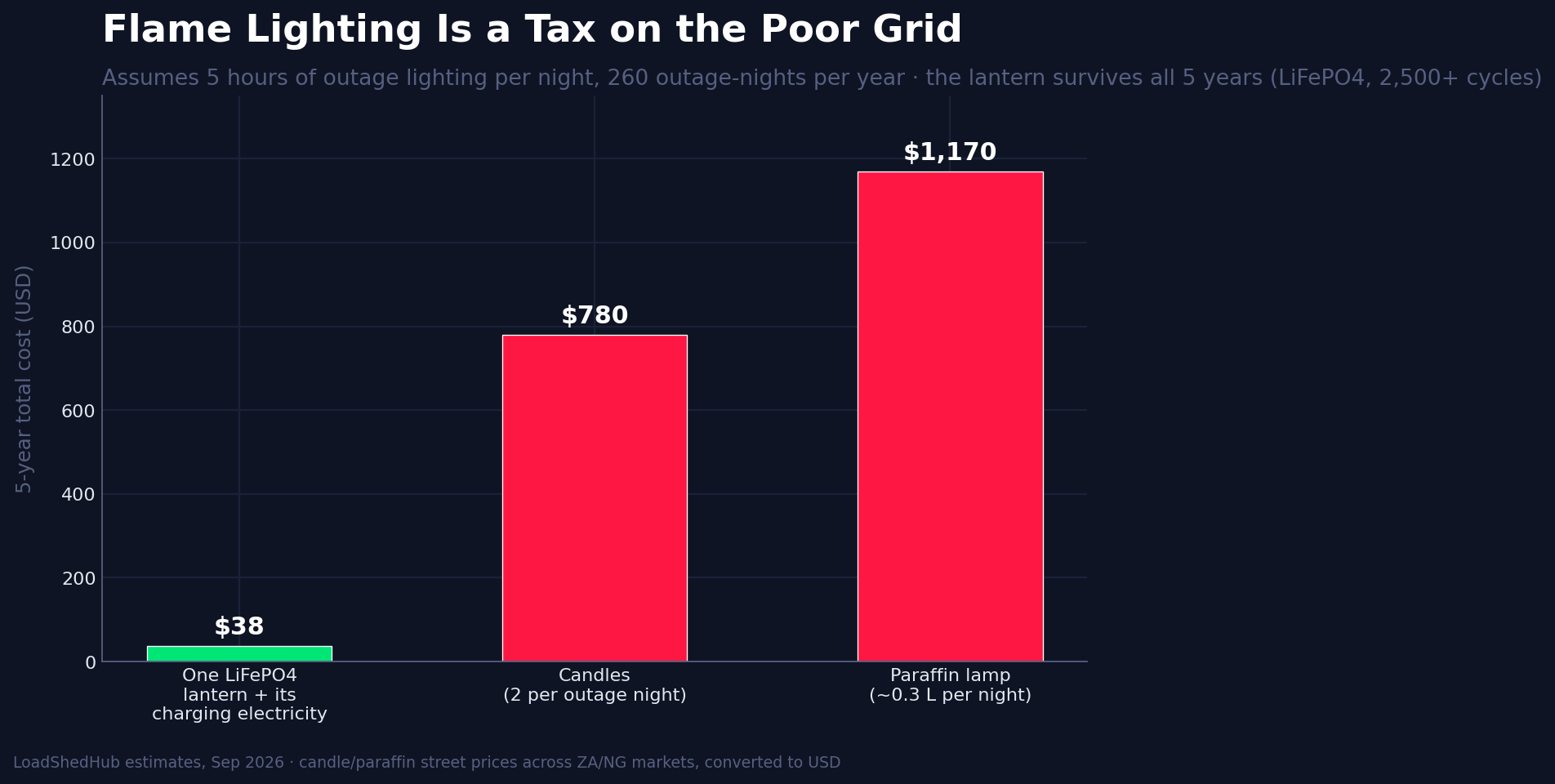
One lantern and its charging electricity cost less than a single month of candles. Multiply across every flame-lit room and the true cost of “cheap” lighting becomes the single most expensive line in a struggling household’s outage budget.
The Three Product Classes
1. The rechargeable bulb (the install-once answer). An LED bulb with a battery inside, shaped exactly like the bulb it replaces. Grid on: it charges. Grid off: it lights—no ritual, no drawers, no thinking. Many double as handheld torches when unscrewed. This is the Gizzu-class classic that South African hardware stores now sell by the pallet, and the single highest-value purchase in this guide.
2. The collapsible lantern (the table answer). 1,000 lm on turbo, ~150 lm for the long haul, usually with a USB-out port that turns it into a power bank for a phone or two. It moves where people gather; it’s the thing children can carry without risk.
3. The solar lantern (the grid-independent answer). Inflatable or folding, ~75 lm, tethered to the sun. For shedding schedules that outlast everyone’s batteries, or off-grid settings, it’s the floor under the whole stack: it never needs the grid you’re missing.
Buying Checklist (Two Minutes)
- Judge battery, not lumens. A “1,000 lm” light with a 12 Wh battery is a 1-hour firework. Look for Wh (or mAh × 3.7 V ÷ 1,000) and expect 5–6 h at 5 W, 25–30 h at 1.5 W.
- Prefer LiFePO4 where offered. It survives years of daily top-ups; generic lithium-ion loses ~20% of runtime after 2–3 years of load shedding duty.
- USB-out (reverse charging) is the hidden feature. A lantern that charges a phone doubles as emergency communications, not just lighting.
- Pass-through charging (lights while charging) keeps a lantern usable as a permanent bedside light rather than a drawer gadget.
- Cold-white for work, warm-white for living. Warm light at 150 lm reads as “evening”; cold light at 150 lm reads as “incident.”
The Picks (2026)
Regional buttons open local retail for your country. “Gizzu-class” and “Luci-class” mean any reputable product of that shape and spec—the categories are global commodities now; verify Wh and charge-cycle claims on the listing before ordering.
Placement and Discipline
- One bulb per lived-in room, prioritizing kitchen, bathroom, and the children’s room. Hallways get the lantern or a headlamp.
- Top up after every outage, not before every one—a habit that finds every battery full, because lithium self-discharge is slow but not zero.
- Test monthly. Thirty seconds per light. Batteries die on a schedule of their own, usually between outages.
- Keep one light plugged in by the bed. The first outage task—seeing—should cost zero seconds.
The Bottom Line
Lighting is where outage prep starts because it’s the cheapest fear to kill: for the price of two movie tickets, every room in the house simply stays lit through every scheduled cut, with no flame in any of them. The next rungs up the ladder cost more and protect more—the router UPS for your work life, a power station for the fridge and medical gear, the full plan in the outage checklist. If outages are a scheduled part of your week, the South Africa guide covers the whole stack from stage 1 to stage 8.
Next: the complete outage checklist | best UPS for router & fiber | best portable power stations | South Africa load shedding guide