
Generator vs Power Station: Which Backup Power Should You Buy? (2026)
Every backup-power conversation eventually lands on the same fork: a fuel generator or a battery power station. Generators have a century of head start; power stations are the new default. Both survive outages fine—but they survive them differently, and picking wrong costs you either money, silence, or safety. Here is the honest comparison, with the numbers that actually decide it.
- Outages are short and frequent (load shedding, rolling cuts) → power station, sized for your worst day. Silent, indoor-safe, zero maintenance.
- Outages are rare but multi-day (hurricanes, ice storms) and you run big loads (well pump, electric heat, medical gear) → generator for bulk energy.
- The best answer for most houses is both: a station for the first silent hours, a generator to recharge it once or twice a day at optimal load. Run your own numbers in the runtime calculator first.
- Never negotiable: generators run outdoors, 20+ feet from any window. Carbon monoxide kills more people after storms than the storms do.
The Core Difference: Fuel You Store vs Energy You Borrow
A generator is an energy converter: it turns stored fuel into electricity, on demand, for as long as you keep feeding it. A power station is an energy borrower: it holds a fixed amount of electricity you charged earlier—from the grid, or from the sun—and when it’s empty, it’s empty until you refill it.
Everything else in this comparison is a consequence of that one difference. Generators trade running costs and fumes for unlimited runtime. Stations trade finite capacity for silence, indoor use, and near-zero cost per recharge. Neither is a better technology; they’re different tools for different outage shapes. The outage checklist starts with “know your risk” for exactly this reason.
What a Kilowatt-Hour Costs You
The sticker price lies. What you actually pay for backup power is dominated by how you refuel it:
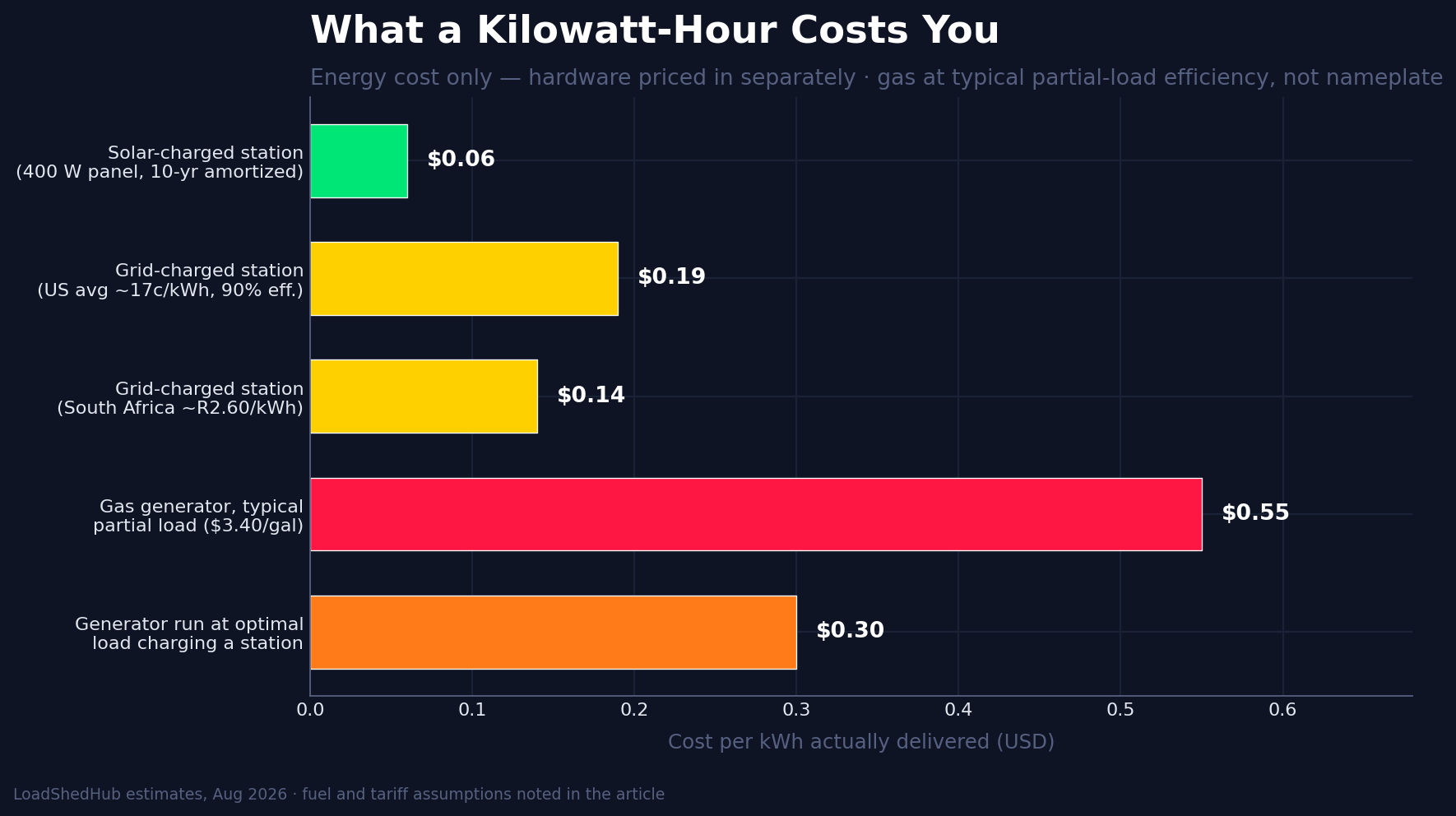
The numbers worth remembering: grid-charging a station costs roughly $0.14–0.19 per kWh depending on your country, while a small generator running at typical partial load lands near $0.55 per kWh in fuel alone. Add a 400 W solar panel and station energy amortizes toward pennies. Where fuel shines is availability: when the outage runs into day three, you can still buy (or store) gasoline. In Nigeria, that single fact made generators the national default.
72 Hours Off-Grid: What Each Kit Delivers
Cost per kWh is half the picture; total energy over a real outage is the other half:
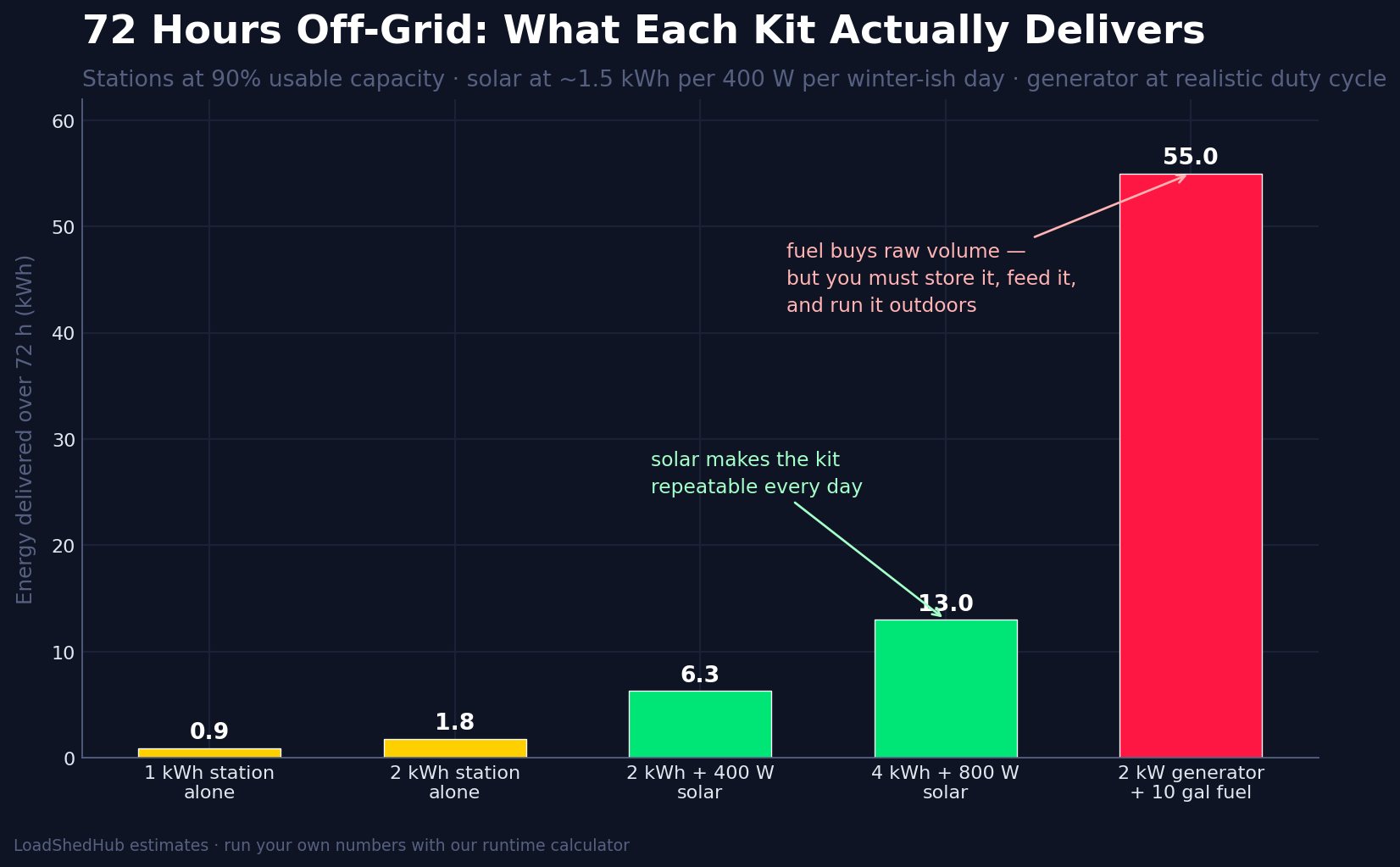
Read that chart twice, because it contains the whole decision. A 2 kWh station alone covers a fridge-and-phones day, then it’s done. Add 400 W of solar and the same station repeats most of that every sunlit day—the solar kit guide shows which panels earn their price. A generator with ten gallons of fuel dwarfs both—if you have the fuel, the outdoor space to run it, and tolerance for ~60 dB of engine noise from dawn.
Head to Head
| Fuel generator (2 kW inverter class) | Power station (1–2 kWh class) | |
|---|---|---|
| Noise | 55–65 dB — a conversation you can’t escape | Silent (fan only under heavy load) |
| Use indoors | Never. CO is lethal; garages count as indoors | Yes — bedroom-safe |
| Apartment / HOA / rental | Usually not allowed or not practical | Completely fine |
| Instant switchover (UPS) | No — manual start, ~10 s–1 min | Yes — <30 ms, electronics never notice |
| Continuous big loads | Yes — 2,000 W+ all day (fridges, pumps, heaters) | Limited by inverter (usually 1,000–2,000 W) and drains fast |
| Refill during a long outage | Buy/store fuel — possible if stations have power | Sun (with panels) or grid when it returns |
| Maintenance | Monthly run, oil changes, fuel stabilizer, carb care | Charge to ~50% and ignore it |
| Shelf readiness | Stale fuel is the #1 “why won’t it start” call | Holds charge for months, tops up from wall |
| Cost to own over 5 yrs | $500–900 + fuel + maintenance | $400–1,200 + ~$0.15/kWh used |
Choose the Generator If…
- Your outages are multi-day events where the grid is physically down (hurricane landfalls, ice storms, wildfire rebuilds).
- You need to run well pumps, electric water heaters, window AC, or power tools—loads above 2,000 W or with hard surge spikes.
- You can store fuel safely and run the unit 20+ feet from the house without argument from neighbors.
- Your outage economy is fuel-based already—the Nigeria guide covers the generator-first reality honestly.
Choose the Power Station If…
- Your outages are short and scheduled (load shedding, PSPS, rolling cuts) — see the inverter guide for the daily-driver version of this logic.
- You live in an apartment, townhouse, or anywhere an engine outside the window isn’t happening.
- Someone in the house needs CPAP, oxygen concentrators, or a router that must stay up — the instant UPS switchover matters. (Keeping Wi-Fi alive is so cheap it has its own guide.)
- You will never perform monthly maintenance. Be honest about this one.
The Hybrid Play (What We’d Actually Buy)
The dirty secret of generators: they’re least efficient—and loudest per watt—at the light loads a house actually draws overnight. The fix is to pair them:
- Size a 1–2 kWh station for overnight essentials (fridge cycling, network, phones, one lamp). It runs silent, indoors.
- Run the generator once or twice a day at 60–80% load to refill the station, top the fuel cans, and run the big stuff (laundry, pump, freezer pre-chill) while it’s on.
- Point solar at the station so sunny days need no fuel at all.
That schedule cuts generator hours from 24/day to 2–4/day—fuel, noise, and maintenance all drop by ~80%. Station picks for each budget are in the best power stations guide; panel economics in the solar kit guide.
Inverter generators and stations both sell through the same channels — brand stores and big retail. Start with the model, not the store:
The Safety Rules (Read This Part Twice)
- Outdoors only, 20+ feet away, exhaust pointed away from buildings. Never in a garage, never under a window, never with the door “just cracked.”
- A battery-powered CO detector in the house is non-negotiable if any fuel-burning gear exists. Grid-powered detectors die exactly when you need them.
- Never backfeed a house through a dryer outlet. Transfer switches exist because linemen get killed by backfeed.
- Store fuel in approved cans, stabilized, rotated every few months. Stale fuel is the top cause of “generator won’t start” on storm day.
The Verdict
For the outage profile most readers of this site have—hours to a day, a few times a year, or scheduled load shedding—a power station plus a panel wins on silence, safety, cost per kWh, and the fact that it’s ready without a single maintenance session. Buy a generator when your realistic worst case is multiple days of heavy loads, then run it as a recharger for the station, not as the house’s heartbeat. And whichever you choose, wire it into the plan from day one: the complete outage checklist.
Next: best portable power stations | solar kits for outages | runtime calculator | inverters for daily load shedding