
South Africa Load Shedding: The Complete Guide (Stages, Schedules, 2026 Status)
Load shedding is the word South Africa gave the world—the practice of switching off electricity to selected areas on a rotating schedule because the grid can’t meet demand. For more than fifteen years it defined South African life: dinner by headlamp, work meetings planned around Stage 6 schedules, and a national industry of inverters, gas stoves, and solar panels.
So where does it stand in 2026? The honest answer: load shedding is currently suspended—and no one trusts that it’s over. This guide explains what load shedding actually is, how the stage system works, where the crisis stands right now, and how to be ready whether the good stretch lasts or the schedule comes back.
What Is Load Shedding?
Load shedding is planned, rotating rationing of electricity. When demand threatens to outstrip what the grid can generate, the utility (Eskom) doesn’t let the whole system collapse—which would be a national blackout taking days or weeks to restart. Instead, it cuts power to selected blocks of customers for a couple of hours at a time, rotating through the country, so the total load always stays under what the plants can supply.
The defining feature is the schedule: unlike a storm outage, load shedding is (mostly) predictable. You know your block, you know the timetable, and for fifteen years South Africans organized their lives around it.
Where Things Stand in 2026
Here’s the status, plainly:
- Load shedding has been suspended since 16 May 2025—more than 400 consecutive days as of this writing, the longest break in the modern crisis.
- Eskom entered winter 2026 declaring the system resilient and stable, crediting its Generation Recovery Plan: units brought back from long-term outages, better maintenance, and billions of rand of private solar that effectively took demand off the grid.
- But load reduction continues. This is the distinction most overseas coverage misses: load reduction is Eskom cutting power to specific overloaded neighborhoods (typically peak hours 05:00–09:00 and 17:00–22:00, on Block A/B/C schedules) to protect distribution equipment. If you live in certain townships and suburbs, the lights still go out—just for a different reason.
- Nobody with a memory is declaring victory. The system’s margin is real but thin; a wet winter coal season, a unit-trip cascade, or a jump in demand as the economy grows could bring stages back. Analysts consistently describe the recovery as fragile rather than fixed.
Practical takeaway: if you’re planning a trip, buying a house, or running a business in South Africa in 2026, plan for a grid that works most of the time—but keep the habits and the hardware that got the country through 2023.
The Stage System, Explained
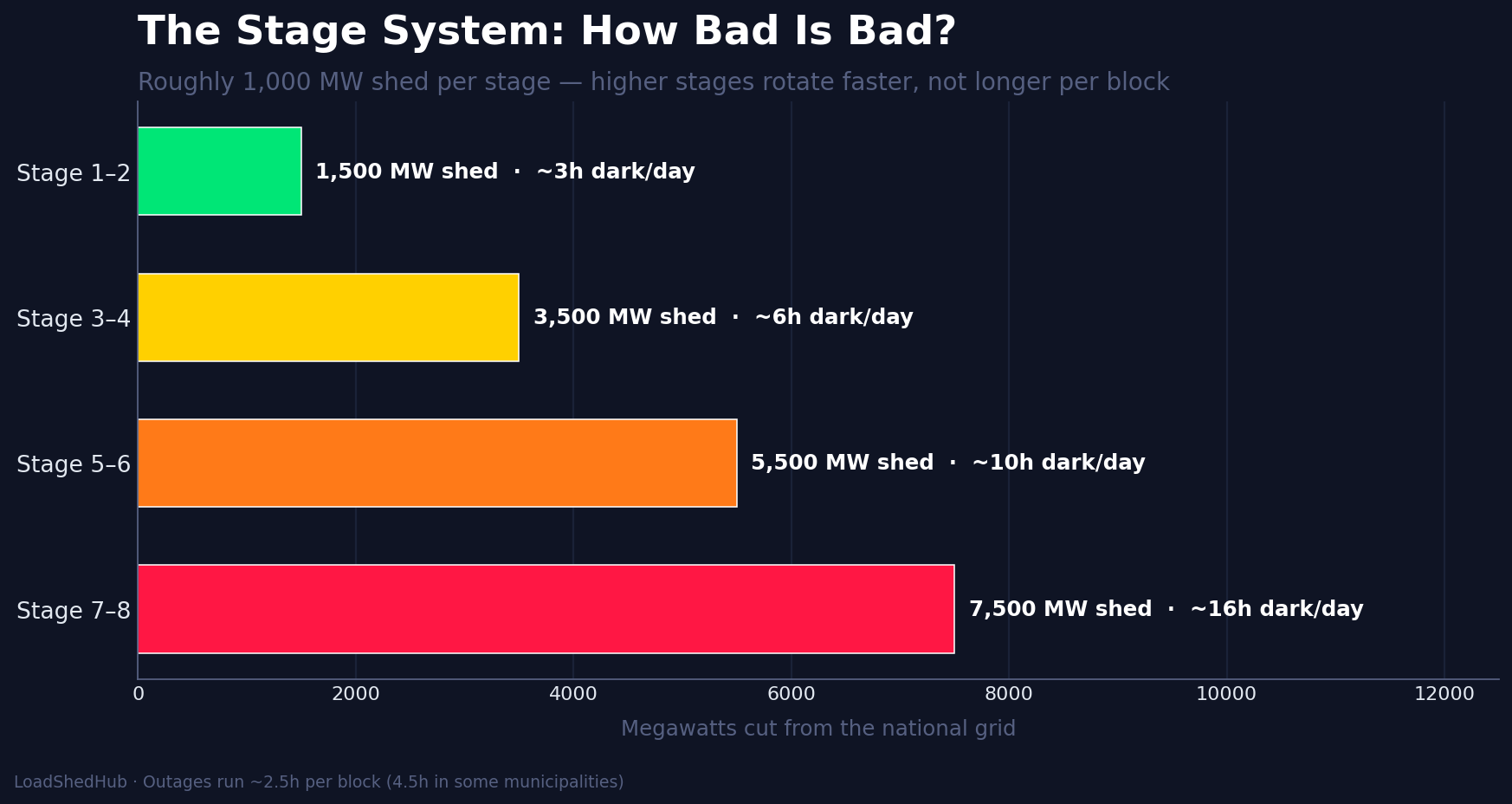
If stages return, you’ll hear “Stage 4 by 16:00” within an hour of it being decided. Here’s what each stage means—roughly 1,000 MW shed per stage, translating to more frequent outages as the number climbs:
| Stage | Grid sheds | What it feels like |
|---|---|---|
| 1–2 | 1,000–2,000 MW | Occasional 2-hour outages; mostly an annoyance |
| 3–4 | 3,000–4,000 MW | Daily outages, 2–3× per day; life reorganizes around the app |
| 5–6 | 5,000–6,000 MW | Outages every block, day and night; 8–10+ hours dark per day |
| 7–8 | 7,000–8,000+ MW | Near-continuous rotation; the country effectively shuts down |
Outages run about 2.5 hours per block (or 4.5 hours in some municipalities), rotating across blocks so that everyone shares the pain. Your block letter + stage = your timetable; every municipality publishes its schedule, and apps like EskomSePush turned checking it into a national reflex.
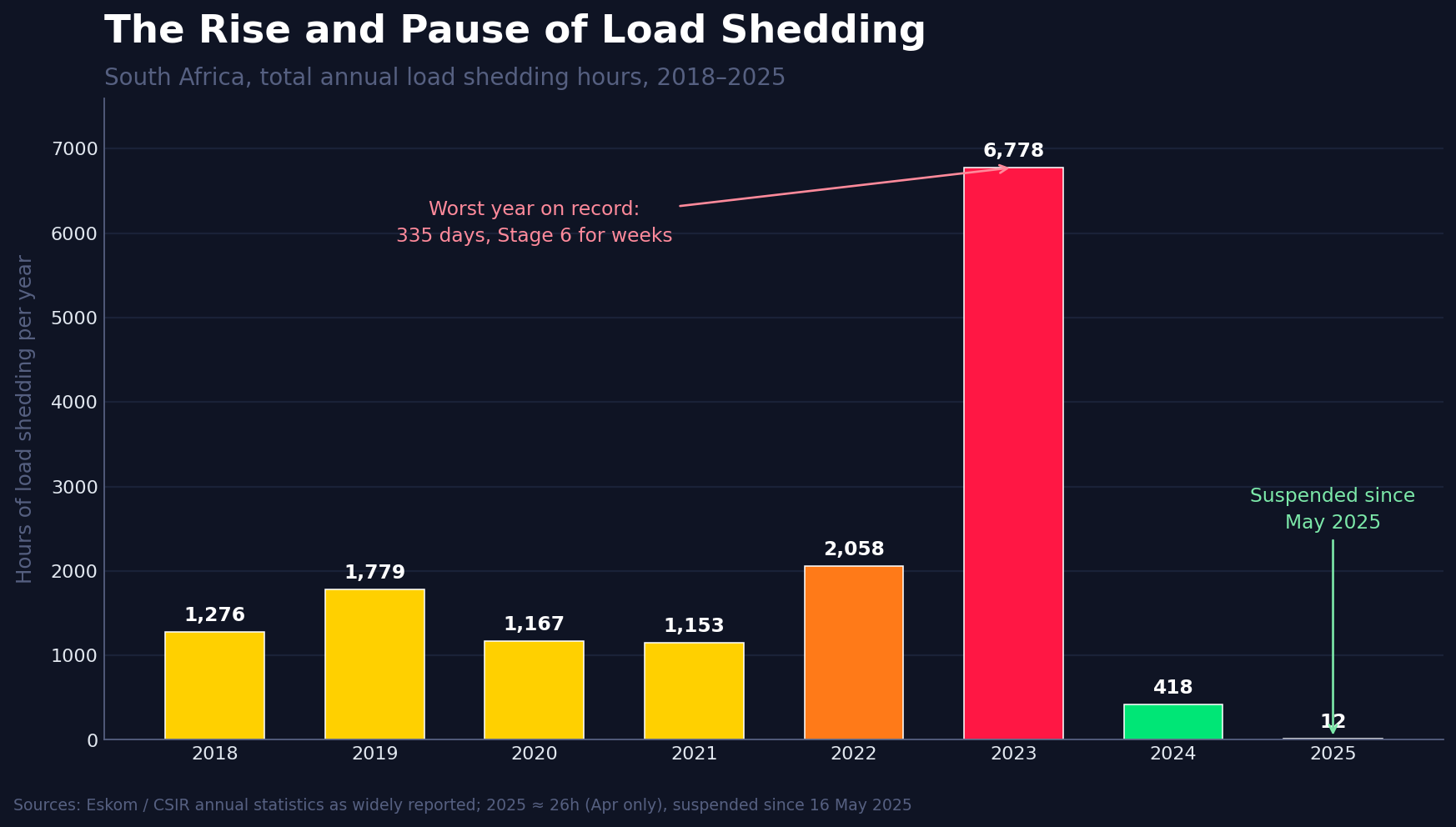
A Fifteen-Year Crisis in Five Numbers
- 2007–2008: the first national load shedding—the warning shot everyone treated as an anomaly.
- 2014–2015: Stage 2 becomes a recurring winter and maintenance-season reality.
- 2019: Stage 6 appears for the first time; “load shedding” enters everyday vocabulary permanently.
- 2023 — the worst year on record: 335 days of load shedding, 6,778 total hours, extended runs at Stage 6, and an estimated cost to the economy in the hundreds of billions of rand.
- 2024–2026 — the great pause: suspension from March 2024 (broken briefly), then continuously since May 2025—the longest stable stretch since the crisis began.
How South Africans Actually Cope
Fifteen years of scheduled darkness built a national playbook—and it’s the most practical advice on this site, because it’s been battle-tested at a scale no other country has experienced:
1. Know your schedule cold. Block letter, municipal schedule, and a schedule app (EskomSePush is the national standard). The outage you see coming costs you nothing; the one that surprises you costs dinner.
2. Get an inverter, not a generator (usually). South Africa’s load shedding is short and frequent—the opposite of a hurricane outage. That profile favors battery inverter systems that charge between outages and run lights, Wi-Fi, TV, and the fridge silently overnight: no fuel, no fumes, no noise. (The cheapest first step is smaller still: a dedicated UPS for the router and fiber ONT keeps you online through every stage.) Light is cheaper still: rechargeable bulbs and lanterns now outfit a whole house for the price of one candle month. Generators still make sense for businesses and long outages, but the middle-class default became a 1–3 kWh inverter/trolley setup, often paired with solar. (Inverter buying guide coming soon.)
3. Solar is the national upgrade path. With electricity prices having risen far faster than inflation for a decade, rooftop solar stopped being green idealism and became arbitrage: panels + inverter + battery means you buy less from Eskom at all, shedding or not. South African households installed gigawatts of it during the worst years—which is partly why the grid recovered.
4. Cook with gas. A two-plate gas stove (about R500–R1,500) kept more South African dinners alive than any battery. The national instinct—load shedding hits, kettle goes on the gas—formed over a million repeat performances.
5. Protect the electronics. Power returning after an outage arrives with surges. South Africans learned to put surge protectors (or UPS units) on TVs, routers, and anything with a board. The outage ends; the surge damage doesn’t have to.
6. Freeze the bottles. Full freezers hold cold longer; frozen bottles fill the gaps. When the schedule says Stage 6, the freezer is your friend.
Will Load Shedding Come Back?
Honest answer: nobody knows, and the people who claim certainty are selling something. The bulls point to the Generation Recovery Plan’s results—units restored, maintenance discipline, and a solar-driven demand drop. The bears point to the system’s history: every previous pause (2021–22’s was the longest) ended with a lurch back into stages when coal performance slipped, and the underlying fleet is still old.
What we’d say: treat 2026 like South Africans treat a long weekend—enjoy it, but don’t sell the inverter.
The Bottom Line
Load shedding gave this site its name because it’s the world’s most instructive outage story: a modern, industrial economy living with scheduled blackouts for fifteen years, and building one of the most sophisticated backup-power cultures on Earth. Whether the current pause becomes the end of the crisis or just a chapter break, the lesson transfers everywhere: know your risk, know your schedule, and own enough backup power that an outage is an inconvenience and not an emergency.
Local stock ships in days, in Rand, with local warranty — no import surprises. Trolley brands: Takealot. Global stations: brand SA stores. Our inverter trolley guide covers what to check.
Next: the global power outage crisis | inverter buying guide | power-station runtime calculator