
UK Storm Power Cuts: The Complete Guide (Including the Money Back)
Britain’s grid is one of the most reliable in the world—and then a named storm arrives. Storm Éowyn in January 2025 delivered 114 mph gusts and disconnected more than a million customers across Scotland and Northern England in a single morning. Storm Darragh in December 2024 peaked at 2.3 million affected. Storm Arwen in 2021 left tens of thousands off supply for days and rewrote the compensation rulebook.
The pattern is consistent: ordinary UK outages are short and rare, but winter named storms increasingly produce multi-day, rural, cold-weather blackouts. This guide covers the UK-specific playbook—including the compensation most people never claim. For general readiness, start with our power outage checklist.
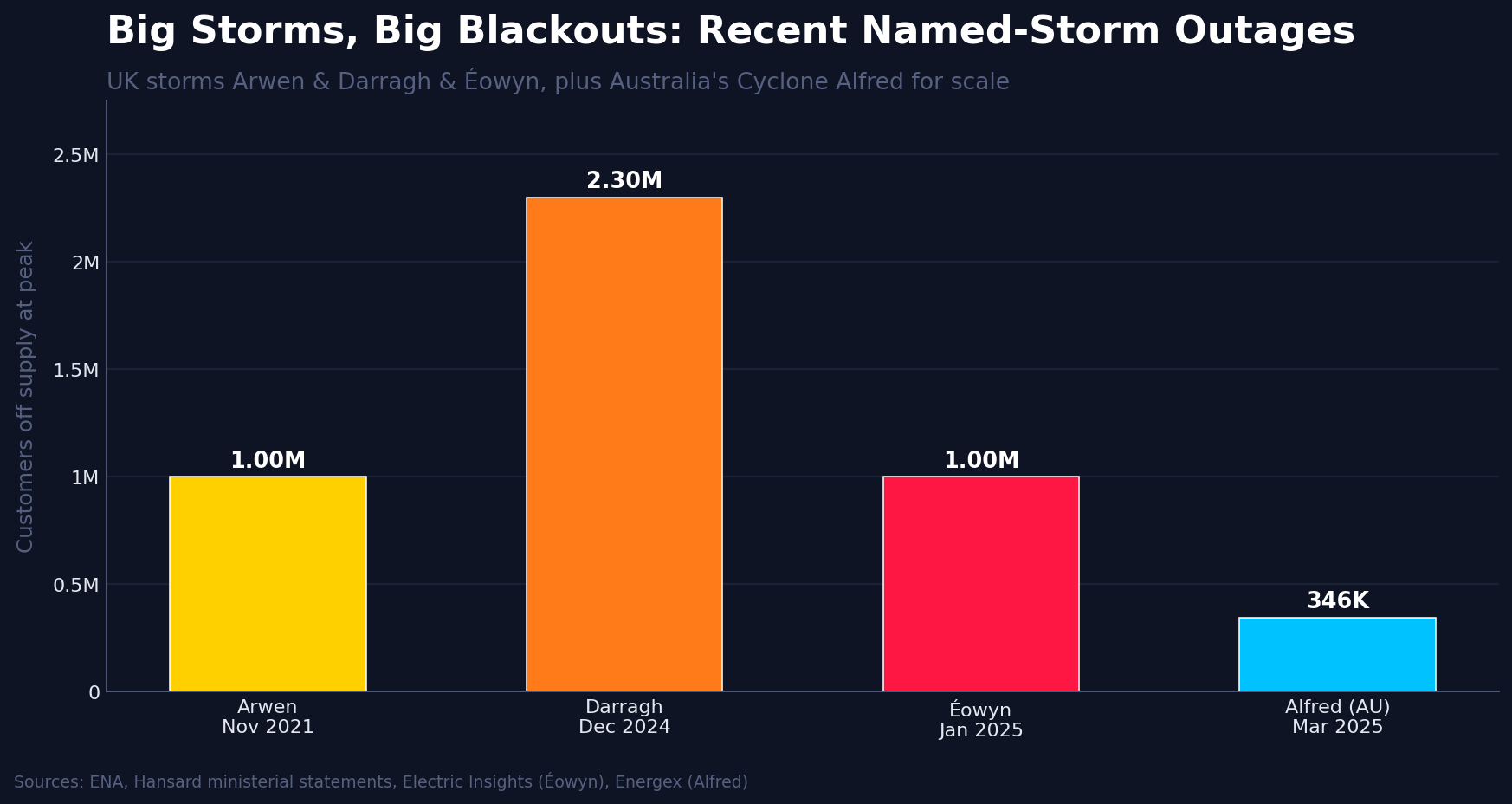
Why Storms Hit the UK Grid Hard
- Overhead lines in windy geography. Rural distribution is largely overhead cable on poles; falling trees and flying debris are the #1 outage cause.
- Storm clustering. UK winters now routinely deliver 5+ named storms (Dudley, Eunice, Franklin in one month in 2022; Bert then Darragh in 2024).
- The rural tail. Cities restore in hours; a single damaged spur line in a valley can leave a village dark for a week while helicopters patrol the network.
- Cold complicates. UK storm outages are winter outages—the same hypothermia and pipe-freeze risks as our winter storm guide covers, in a milder but still dangerous register.
The UK-Specific Playbook
1. Know your DNO and the 105 number. Your electricity is delivered by a regional Distribution Network Operator (not your supplier). 105 is the national power-cut emergency line, and 105Text for SMS. Save both now; they work during data outages.
2. Sign up for the Priority Services Register. If anyone in your household is elderly, disabled, chronically ill, or relies on medical equipment, your DNO’s PSR gets you advance warnings, priority support, and welfare checks during outages. It’s free, it’s underused, and it is the single highest-value 5 minutes a UK household can spend on preparedness.
3. Claim the compensation—it’s automatic in theory, dormant in practice. Ofgem rules: cut off 48+ hours in normal conditions → £85, plus £45-ish per subsequent 6 hours, capped around £2,000+ for severe-weather events. The catch: payments often require claiming within deadlines, and most households never do. After every major storm, check your DNO’s outage page for the claim window.
4. Prep the kit the UK way. Torch per person (headlamps beat torches when you’re fussing with a fuse box), battery radio for updates, thermos flasks filled before the storm lands, blankets, and a charged power bank. UK homes rarely have generators—and rarely need them; a portable power station in the 300–1,000 Wh range covers the realistic UK outage: phones, router, lights, and the fish tank. Just keeping the broadband alive costs far less: a small router UPS does that job on its own.
5. Watch the freezer and the pipes. The food rules are universal (4h fridge / 48h full freezer—see our checklist), and a UK winter outage long enough to claim compensation is long enough to drip your taps and know where your stopcock is.
What to Buy (If Anything)
The honest UK answer: most households need a good torch, a power bank, and registration on the PSR—not a generator. If storms knock your area out repeatedly (rural Wales, Scotland, Cumbria, the South West), a 1 kWh-class power station keeps the router, phones, lamps, and a CPAP alive through the typical 12–48 hour event. Size it honestly with our runtime calculator. Solar matters less here than in storm country abroad—UK storm weather is exactly when panels produce least—so prioritize battery capacity over panels.
The Bottom Line
The UK grid fails rarely and repairs impressively—but the failure mode is now “named storm, million customers, rural tail for days,” and the winters are getting windier. Register for the Priority Services Register, save 105, know the compensation rules, and keep a power bank that’s actually charged. That’s the difference between an adventure and an ordeal.
All three big brands run UK stores — prices in pounds, UK plugs and sockets, local warranty. Model picks are in our station guide; every card there has a UK button.
Next: the complete outage checklist | best portable power stations | runtime calculator | the global picture