
Australia Power Outages: Storms, Heat, Fires, and the Solar Advantage
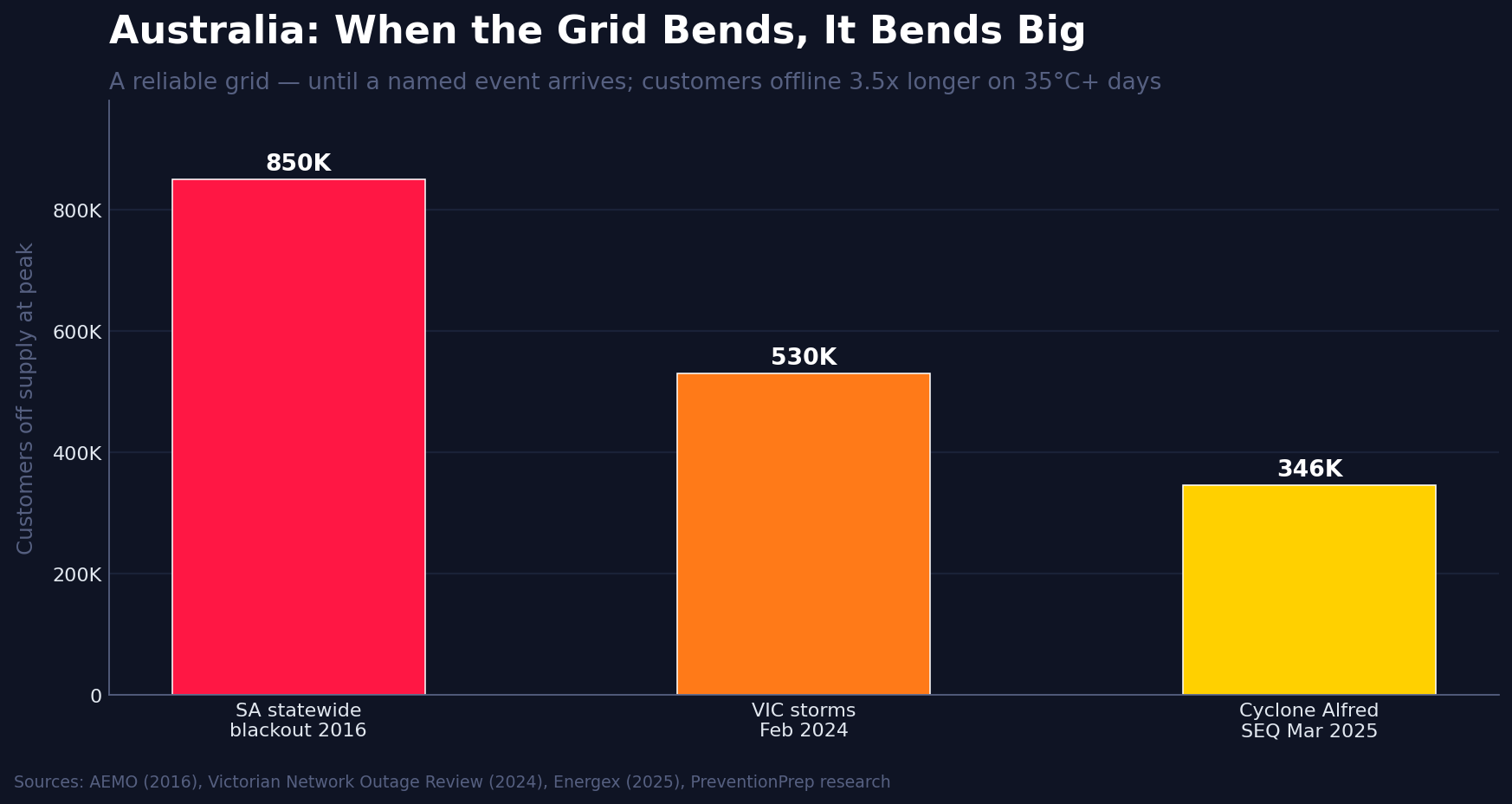
Australia’s grid is world-class reliable—right up until it isn’t. The 2016 South Australian storm took out 850,000 customers in a statewide blackout. Victoria’s February 2024 storms disconnected 530,000+—the state’s largest-ever outage event, damaging 12,000 km of network. Ex-Cyclone Alfred in March 2025 peaked at ~346,000 across South East Queensland, with tens of thousands still off supply days later.
The Australian pattern: a strong grid that fails big when heat, wind, fire, or flood arrive—and a continent where backup power doubles as a lifestyle. This guide covers the local playbook. For general readiness see our complete checklist.
The Four Australian Outage Modes
1. Storms and cyclones. East-coast lows and ex-tropical cyclones bring down trees and lines. Expect hours-to-days outages; the Cyclone Alfred tail ran over a week for some.
2. Heatwaves. Australia’s grid strains exactly when demand peaks: customers are offline 3.5x longer on days over 35°C. Heat outages are also health emergencies—no power means no fans, no cooling, no refrigeration of insulin, precisely when heat is dangerous.
3. Bushfires. Fires destroy networks directly, and Australia has adopted California-style pre-emptive shutoffs in extreme fire-risk conditions—see our PSPS guide for that playbook, which increasingly applies here too.
4. Floods. Water floods substations and undercuts poles; restoration waits for the water to leave.
The Australian Playbook
1. Summer is your storm season. The northern hemisphere preps for winter; Australia’s outage risk peaks December–March. Do the kit check in November, not June.
2. Solar is the national superpower—with a catch. A third of Australian homes have rooftop PV, but most systems shut down when the grid dies (anti-islanding protection) unless you have a battery or a backup-capable inverter. If you’re buying solar, ask about blackout backup explicitly; if you have a battery, learn its backup mode before summer.
3. A battery station covers the realistic case. The typical Australian outage is 4–24 hours. A 1–2 kWh portable power station runs the fridge, router, phones, fans, and a CPAP through it; paired with a solar panel—and Australian sun—you can stretch indefinitely. For cyclone country (QLD, NT, northern WA), where multi-day outages and no-travel windows are real, size up to 2+ kWh.
4. Know the local lifelines. Your distributor’s outage map (Energex, Ausgrid, AusNet, Western Power…), the SES for storm damage, and Lifeline for welfare checks. In heat events, councils open relief centres—know yours before you need it.
5. Generator rules apply. Rural properties running generators after cyclones: outdoors, 20 feet clear, never under the carport, CO alarms in the house. The rules don’t relax because it’s Queensland.
Sizing Notes for Australian Homes
Fridges in 40°C laundries cycle harder (budget ~30% less runtime than our standard estimates—the runtime calculator gives conservative baselines). Add the garage beer fridge to your list, and remember: a chest freezer holds cold far longer than an upright—in a heat outage, upright freezers are the weak point.
The Bottom Line
Australia has reliable power and extreme weather, and the gap between those two facts is where outages live. The winning combo is unglamorous: a November kit check, a right-sized battery station, a backup-capable solar system if you’re lucky enough to have PV, and a plan for heat that treats a blackout as a health event. When Cyclone Alfred’s tail hit day five, the households that slept well were the ones with a charged battery and a known relief centre.
All three big brands run Australian stores — prices in AUD, local warranty and support. Model picks are in our station guide; every card there has an AU button.
Next: best portable power stations | solar generator guide | runtime calculator | the global picture